
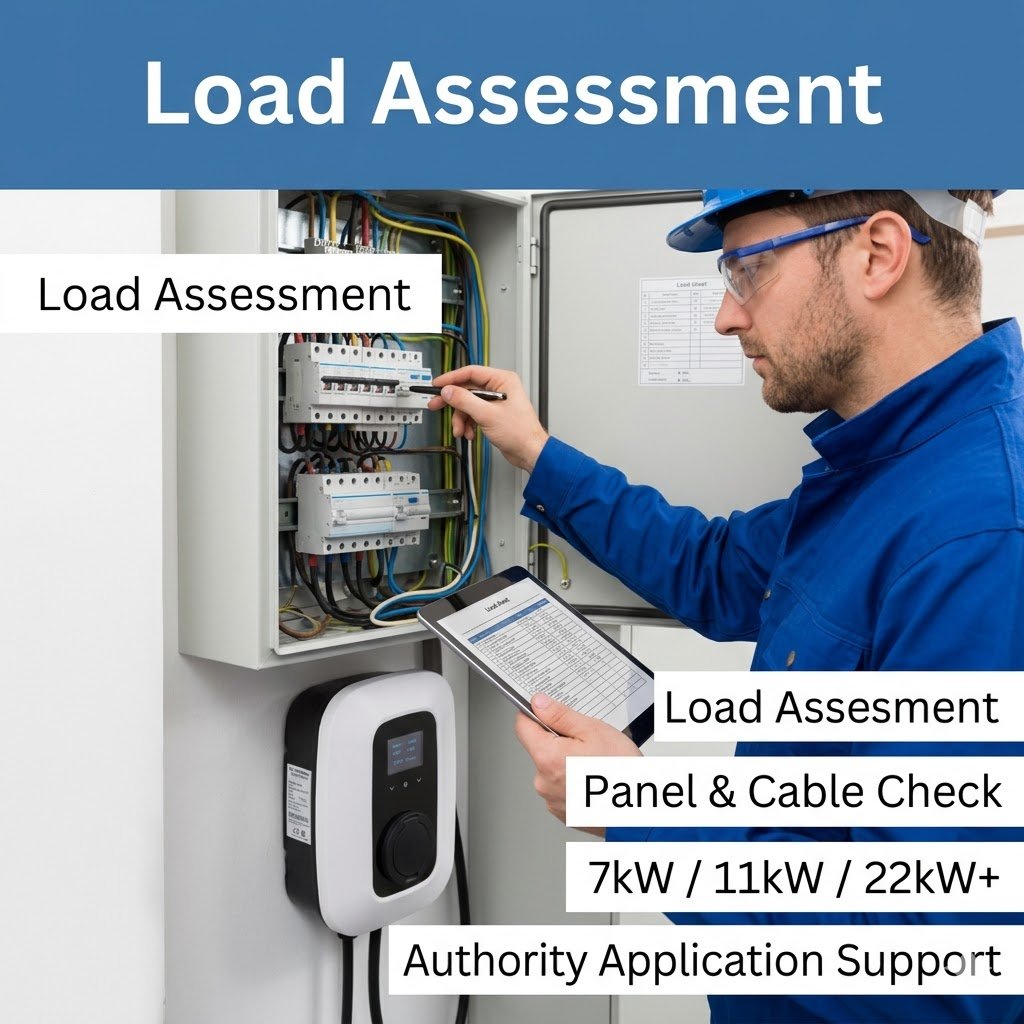
EV Charger Load Certificate and Load Increase Study in UAE
Installing an EV charger is not only about choosing a wallbox. The electrical supply must also support the new load safely.
This is especially important for 22kW chargers, multiple charging points, dealerships, workshops, fleets and commercial DC chargers.
MEV Charger provides site inspection, load calculation and technical reporting for EV charger projects across the UAE.
What Is an EV Charger Load Certificate?
Customers often use the term “load certificate.” The more accurate term is an electrical load assessment report or load increase study.
The report can show:
- Proposed charger load
- Number of charging points
- Required current
- Available electrical capacity
- Main panel condition
- Cable and breaker suitability
- Whether a load increase may be required
When Is a Load Study Recommended?
- Electrical capacity is unknown
- An 11kW or 22kW charger is planned
- More than one charger will be installed
- The main breaker is heavily loaded
- Breakers trip repeatedly
- A commercial or fleet project is planned
- The consultant requests a load schedule
- The authority requests drawings or load details
What We Check
Main Distribution Board
Main breaker, spare ways, busbar, connected loads and available capacity.
Existing Loads
Air conditioning, lifts, pumps, machinery and other major equipment.
Proposed EV Load
Number of chargers, charger rating and expected simultaneous use.
Cables and Route
Cable size, route length, voltage drop and installation method.
Protection and Earthing
Breaker, RCD/RCBO, isolation, short-circuit protection and protective earth.
Typical Charger Load Examples
| Charger | Typical Supply | Approximate Current |
|---|---|---|
| 7kW AC | Single phase | About 32A |
| 11kW AC | Three phase | About 16A per phase |
| 22kW AC | Three phase | About 32A per phase |
| 44kW Dual-Gun AC | Three phase | Depends on load sharing |
| DC Charger | Three phase | Depends on input power and efficiency |
These are planning values. Final design depends on the charger, cable length, demand strategy and authority requirements.
What the Report Can Include
- Site and client details
- Existing supply and main breaker
- Existing load estimate
- Proposed EV load
- Total connected load
- Maximum-demand estimate
- Recommended cable and breaker
- Earthing observations
- Load schedule
- Single-line diagram where required
- Installation or load-increase recommendation
Does the Report Guarantee Approval?
No. Final approval belongs to the relevant electricity authority and may require an approved consultant, contractor, municipality, landlord or building management.
Authorities in the UAE
Dubai — DEWA
EV charging projects in Dubai must follow DEWA technical and regulatory requirements. Public charging operations may also require a CPO licence.
Sharjah — SEWA
SEWA is the electricity authority in Sharjah. Submission requirements depend on the site and project.
Northern Emirates — EtihadWE
Etihad Water and Electricity is the current name of the authority formerly known as FEWA.
Abu Dhabi — TAQA Distribution
TAQA Distribution provides electricity-load approval and load-upgrade inspection services. Documents may include drawings and load schedules.
Do You Always Need a Load Increase?
No. Some sites have enough spare capacity. Others can reduce the upgrade by using:
- Lower charger power
- Dynamic load management
- Scheduled charging
- Load sharing
- Phased installation
Example: Five 22kW Chargers
Five 22kW chargers have a connected rating of 110kW. However, approved load management can limit simultaneous demand and distribute the available power.
Who Needs This Service?
- Villa owners
- Apartment buildings
- Car showrooms
- Workshops
- Commercial parking
- Hotels and offices
- Fleet operators
- Developers and government projects
Our Process
- Receive site and charger details
- Inspect the electrical system
- Calculate the EV load
- Check panel, cables, protection and earthing
- Recommend charger power
- Prepare the report
- Support the consultant or authority process where applicable
- Install after approval
Conclusion
A load assessment helps prevent overloaded breakers, undersized cables, unsafe connections and unnecessary upgrade costs.
MEV Charger can inspect the site, calculate the load and prepare a clear technical report. Final approval remains subject to the relevant authority and approved project parties.
Need a charger or installation?
Choose your vehicle or plan the installation.
FAQs
What is an EV charger load certificate?
Is it an official utility approval?
When is a load study needed?
What does the inspection include?
Can it support a DEWA or SEWA application?
What is FEWA called now?
Who handles Abu Dhabi load applications?
Do five 22kW chargers equal 110kW?
Can load management avoid a load increase?
What documents may be required?
Related Articles

EV Charger Approval in the UAE: Villas, Apartments and Buildings
A practical, authority-aware guide to the permissions, electrical checks and documents to confirm before inst…
EV Charger Installation in the UAE: The Complete Home Guide
A practical, evidence-led guide to choosing power, surveying the site, planning cable and protection, and ins…