
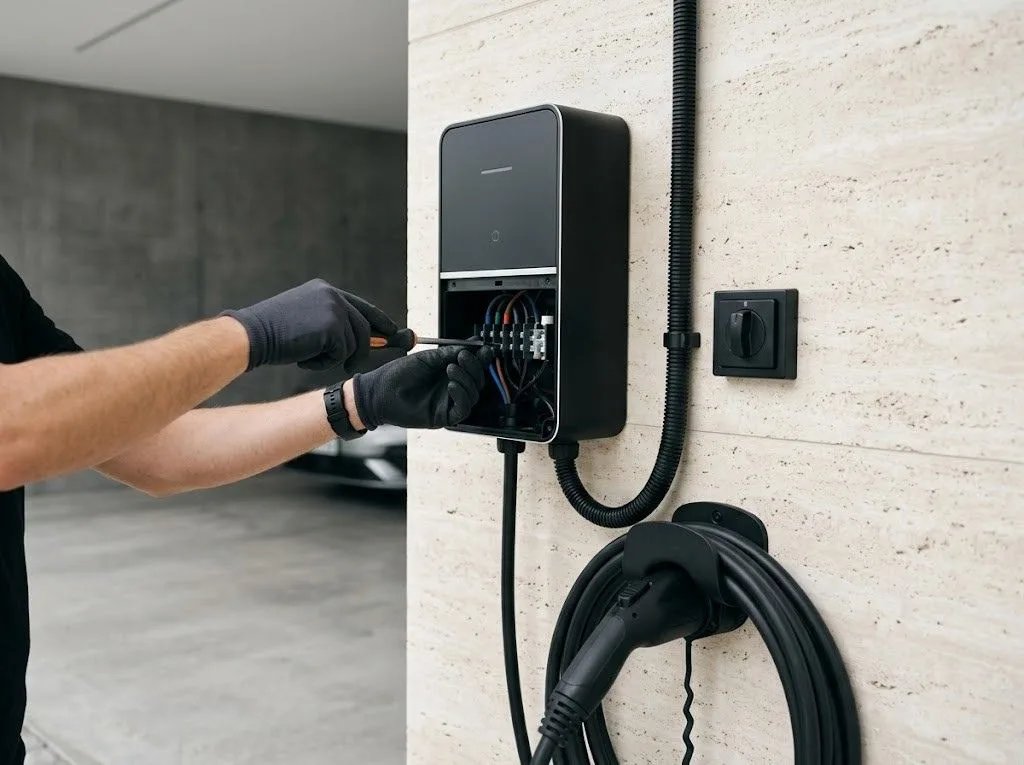
Short answer: there is no single approval that covers every EV charger installation in the UAE. The correct route depends on the Emirate, who owns or manages the property, where the electricity comes from, whether the cable crosses a common area, and whether the charger is for private use or a charging service.
A quotation and an approval are not the same thing. A preliminary quote can estimate the charger, cable, protection and route. Permission to carry out the work may still depend on the property owner, building management, parking authority, distribution company or another competent authority.
The five decisions to confirm before buying a charger
| Decision | Evidence to collect | Why it matters |
|---|---|---|
| Right to use the parking bay | Title deed, tenancy terms, allocated-bay record or management confirmation | A nearby parking space does not automatically give permission to install equipment or route a cable. |
| Electricity source | Account or meter identity, main-board photographs and supply details | The charger must not be connected to an unverified common or third-party supply. |
| Available capacity | Main breaker, phase arrangement, existing loads and any load assessment | The wallbox rating must fit the car and the property; the largest charger is not always the correct charger. |
| Cable route | Video from the board to the bay, approximate distance and civil-work points | Common corridors, fire-rated walls, roads, interlock, ceilings and outdoor exposure can change both approval and design. |
| Approval path | Written response from the owner, management and relevant authority where required | Verbal permission is difficult to prove and may not cover electrical or civil work. |
Dubai: verify the current DEWA and property process
DEWA maintains a dedicated regulatory framework resource for EV charging infrastructure and links to electricity connection, fit-out contractor and technical resources. The exact process depends on whether the project is a private home charger, a charger in managed parking, or a commercial charging service.
For a Dubai villa, first confirm ownership or landlord permission, the supply account, available load, main-board condition and the proposed route. For an apartment or shared car park, obtain a written building-management response before drilling, crossing common areas or connecting to a common service. The building may request drawings, contractor documents, load information, product data or a method statement.
Do not present a quotation as a DEWA approval. The current DEWA process and any building or municipality requirement should be checked for the actual premises before work begins.
Abu Dhabi: DoE policy separates private use from charging services
The Abu Dhabi Department of Energy policy applies to charging infrastructure in public parking, private parking and self-provision. It defines self-provision as non-commercial charging for personal residential use, including villas, townhouses and Shaabiat, or charging for one entity fleet.
The policy also says the distribution company should publish connection criteria and procedures. It describes dedicated EVSE metering, distribution-company verification under the Electricity Wiring Regulations, and conformity requirements for EV supply equipment. These points make the source account, equipment record and inspection route important parts of an Abu Dhabi project.
The same policy states that an operational licence or permit from DoE is not required merely to own or operate EVSE. This must not be misread as “no approval is ever needed.” Distribution connection, electrical verification, parking, building-management, landlord, commercial-activity and other requirements may still apply to the particular site.
Sharjah, Ajman and the Northern Emirates
Do not copy a Dubai or Abu Dhabi checklist and assume it is automatically valid elsewhere. Confirm the current process with the electricity authority or distribution company serving the property, plus the owner, landlord or building management. The electrical design still needs the exact supply, route, environment, charger instructions and vehicle limit.
Where a public online instruction is not available, ask for the requirement in writing and keep the reply with the project file. A professional proposal should clearly mark every item as confirmed, estimated or awaiting authority or management confirmation.
Villa installation checklist
- Confirm the person authorising the work and the electricity account used.
- Photograph the main board, main breaker and proposed charger location.
- Record single-phase or three-phase supply and the car onboard AC limit.
- Map the complete cable route, not only the straight-line distance.
- Identify interlock, wall openings, ceilings, outdoor heat, water and vehicle impact risks.
- Separate charger, cable, protection, isolator, civil work, testing and approval-related exclusions in the quotation.
- Do not energise the charger until the required electrical tests and vehicle charging test are completed.
Apartment and shared-building checklist
Apartment projects require more than finding a socket near the parking bay. Confirm the legal or allocated bay, the source meter, the route through common areas, how energy will be billed, who maintains the charger, and how emergency isolation will be handled.
Ask building management which documents it needs. Common requests may include a charger data sheet, contractor credentials, route drawing, load information, civil-work method, insurance or a no-objection letter. The exact list is building- and authority-specific; it should never be invented by the installer.
Commercial sites and more than one charger
A workplace, fleet or customer charging service has different questions from a private home charger. Simultaneous demand, metering, user access, payment, maintenance responsibility and commercial approvals can become relevant. A single 7 kW home-charger template is not a design for a multi-charger car park.
What to send for a useful preliminary report
- Vehicle model year, market version and a clear photograph of the open charging inlet.
- Main-board and main-breaker photographs with labels readable.
- A continuous route video from the board to the proposed charger position.
- Approximate distance and every wall, ceiling, interlock or road crossing.
- Property type, Emirate, parking ownership and any management correspondence already received.
Use the MEV installation planner to organise these details and receive an itemised preliminary report. Then read the complete UAE installation guide, the load and supply guide, and the 7/11/22 kW comparison before selecting equipment.
Final rule: document what is known and what is pending
A reliable installation file should separate three things: confirmed property and vehicle facts, calculated electrical estimates, and approvals or measurements still pending. This prevents a sales estimate from being mistaken for final engineering or authority acceptance.
Official sources
Battery, connector and charging limits can vary by model year, trim and market. Confirm the exact vehicle before buying equipment.
- DEWA — Regulatory Framework for EV Charging Infrastructure Official Dubai regulatory resource and links to electricity connection, contractor and technical information.
- Abu Dhabi DoE — Regulatory Policy for Electric Vehicle Charging Infrastructure Policy scope, self-provision definition, distribution-company procedures, EVSE metering, verification and licensing distinctions.
- Abu Dhabi DoE — EV charging infrastructure policy announcement Official summary of the policy purpose, stakeholders and ownership, installation and management scope.
- Abu Dhabi DoE — Electricity Wiring Regulations 2020 Electrical-installation framework referenced by the Abu Dhabi EV charging policy.
- U.S. DOE AFDC — Charging Electric Vehicles at Home Authoritative general guidance on code-compliant installation, contractor knowledge and local permitting confirmation.
Need a charger or installation?
Choose your vehicle or plan the installation.
FAQs
Do I always need an NOC to install an EV charger?
Does the Abu Dhabi policy mean no approval is required?
Can I use a socket in a shared car park?
What documents should I prepare before asking for a quote?
Is authority approval included in the installation price?
Does a smart wallbox make approval automatic?
Related Articles
EV Charger Installation in the UAE: The Complete Home Guide
A practical, evidence-led guide to choosing power, surveying the site, planning cable and protection, and ins…
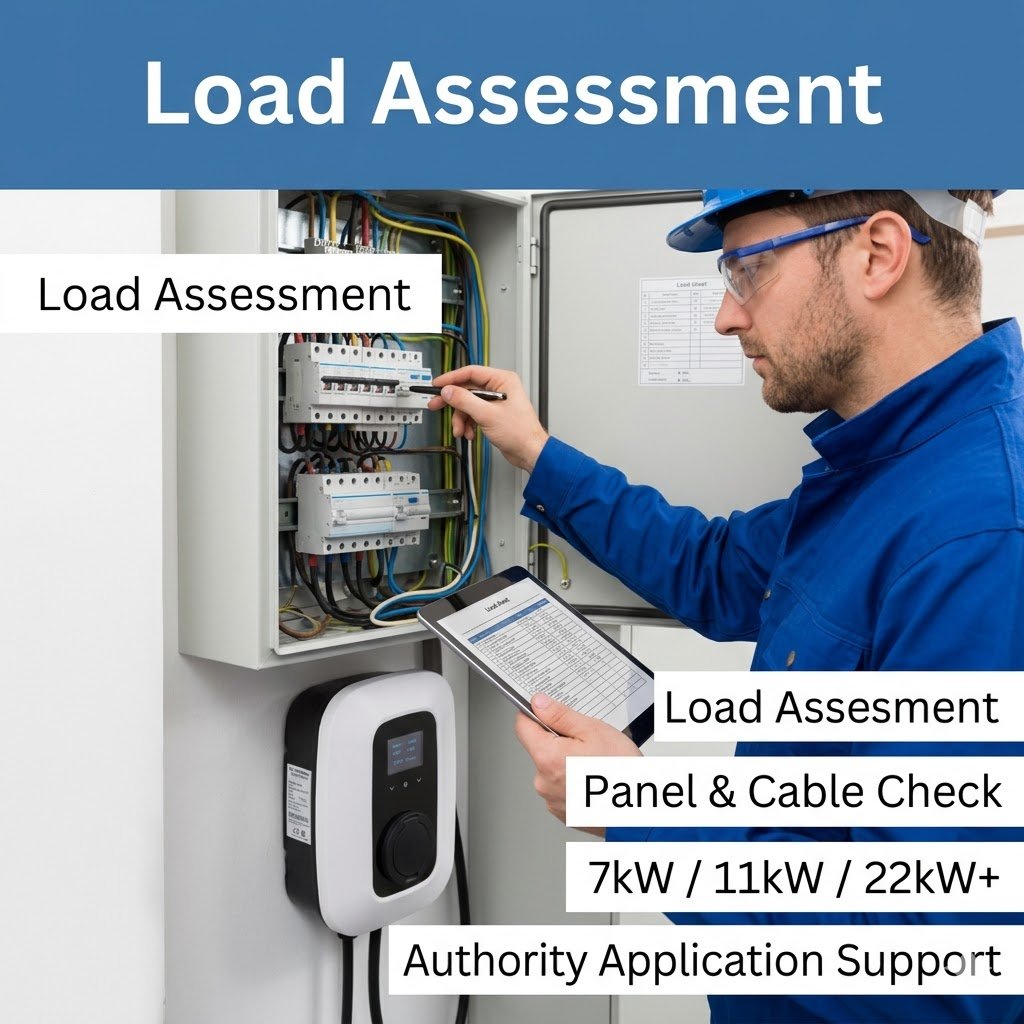
EV Charger Load Certificate & Load Increase Study in UAE
Professional EV charger load assessment in the UAE, including site inspection, load calculation, panel and ca…

7 kW vs 11 kW vs 22 kW EV Chargers in the UAE
Choose charger power from the car, available phases and overnight energy need—not the largest number on the b…
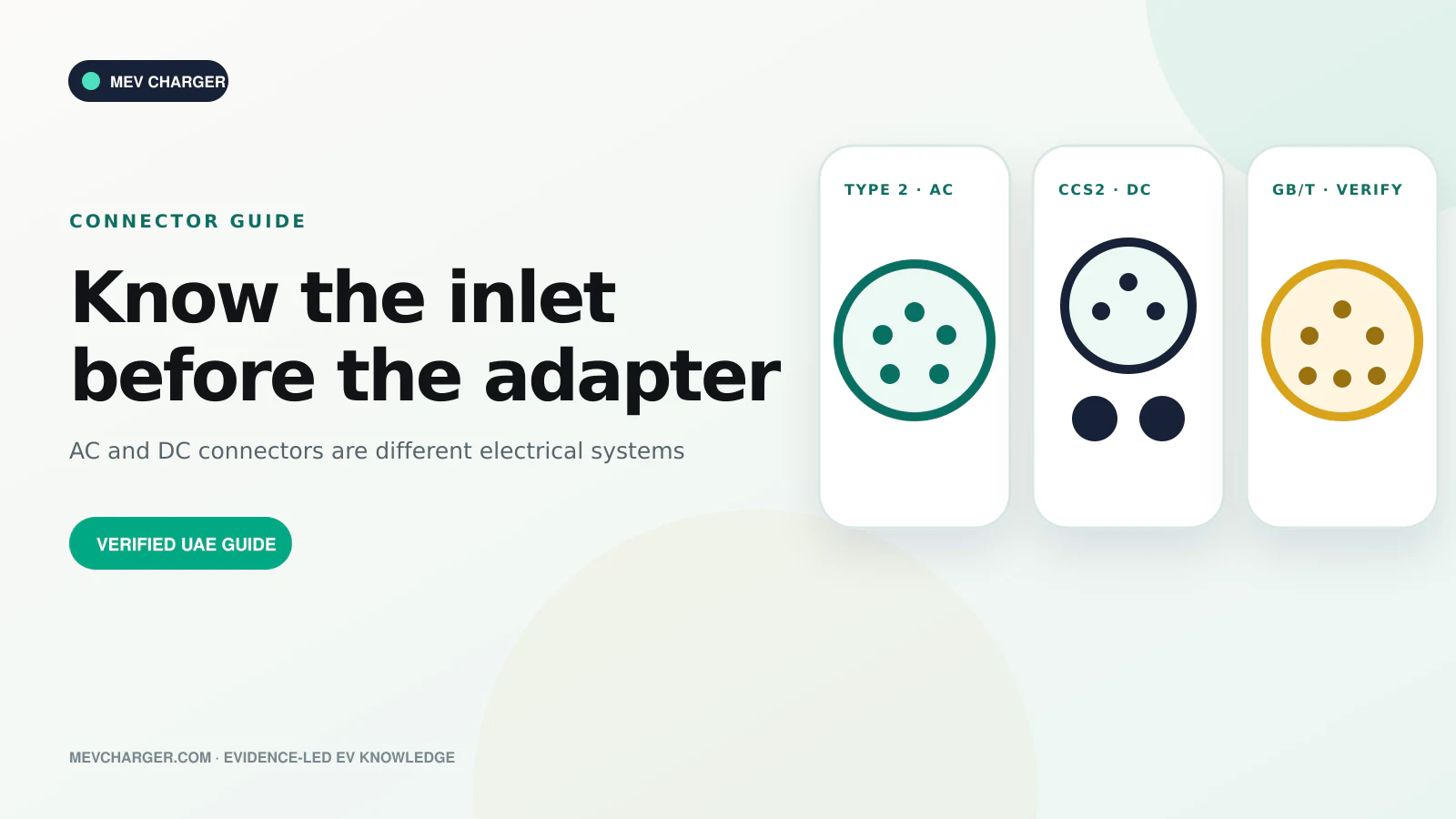
EV Charging Connectors in the UAE: AC, DC, Type 2, CCS2 and GB/T
Identify the correct charging port before buying a wallbox or adapter. This UAE guide explains AC versus DC, …