
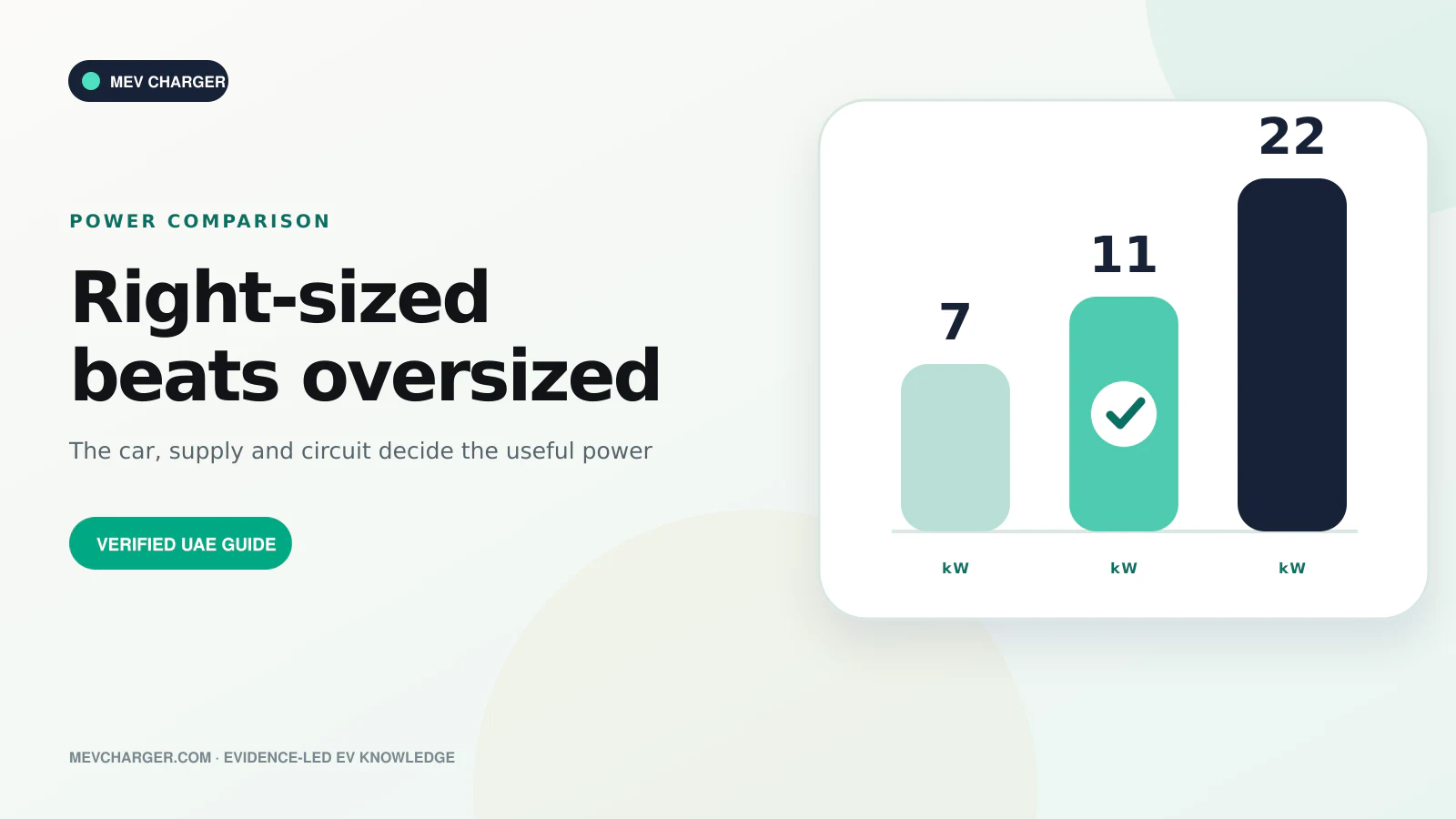
Best general rule: choose the smallest power that comfortably restores your normal daily energy within the parking window, provided the car and property support it. A larger wallbox cannot override the vehicle’s onboard AC charger.
Side-by-side comparison
| Nominal wallbox | Common electrical arrangement | Nominal energy in 8 hours* | Best fit |
|---|---|---|---|
| 7–7.4 kW | Single-phase, about 32 A | 56–59 kWh | Most overnight home use and single-phase cars |
| 11 kW | Three-phase, about 16 A per phase | 88 kWh | Cars with 11 kW onboard charging and suitable three-phase supply |
| 22 kW | Three-phase, about 32 A per phase | 176 kWh | Cars that truly accept 22 kW or sites with a justified multi-use plan |
*Power × time before charging losses, vehicle limits, current reduction or battery management. These figures are not promised battery energy.
Step 1: find the car’s onboard AC limit
Do not use the DC fast-charging number. A vehicle advertised with 150 or 300 kW DC may accept only 7, 11 or another value on AC. Check the exact model year and market specification because imported versions can differ. If the official specification is unclear, verify the label/manual and charging screen.
Step 2: confirm single-phase or three-phase supply
A 7 kW class charger is commonly practical on an appropriately designed single-phase circuit. An 11 or 22 kW AC wallbox normally needs three-phase supply. Having three phases at the building does not prove spare capacity exists at the selected panel.
Step 3: calculate the energy you actually need overnight
If you drive 100 km per day and the car uses an observed 20 kWh/100 km, the battery needs about 20 kWh plus charging losses. Even a 7 kW charger can normally restore that amount within a typical overnight window. Use your own consumption, not a marketing range.
| Daily battery energy | Ideal time at 7 kW | Ideal time at 11 kW | Ideal time at 22 kW |
|---|---|---|---|
| 20 kWh | 2 h 51 min | 1 h 49 min | 55 min |
| 40 kWh | 5 h 43 min | 3 h 38 min | 1 h 49 min |
| 60 kWh | 8 h 34 min | 5 h 27 min | 2 h 44 min |
Ideal battery-energy division only. Add a realistic allowance for losses and any power taper; actual time can be longer.
When 7 kW is the smarter choice
- The car is limited to single-phase AC or around 7 kW.
- Normal daily energy is modest and the vehicle parks overnight.
- The property has limited spare capacity.
- You want a simpler load profile rather than unused nameplate power.
When 11 kW earns its place
Eleven kilowatts is often the balanced three-phase option: it can substantially shorten recovery after a long drive without the connected load of 22 kW. It is valuable only when the exact vehicle accepts it and the site can supply it continuously.
When 22 kW is justified
Use 22 kW when the vehicle’s onboard charger accepts it, turnaround is genuinely short, or the charger is part of a managed shared-site strategy. Installing 22 kW “for future proofing” can be reasonable only after checking cable route, protective design, capacity and load management; the future charger can also be upgraded later.
Portable charger or wallbox?
Power is not the only distinction. A fixed wallbox can offer dedicated protection coordination, cable management, authorization, scheduling and load management. A portable charger adds mobility but still requires a suitable supply point and must not be treated as permission to use any convenient socket continuously.
Final decision checklist
- Exact car and market version.
- Physical inlet and onboard AC limit.
- Daily kWh and overnight hours.
- Single- or three-phase supply and spare capacity.
- Surveyed cable route and protection design.
- Smart features actually needed: app, RFID, scheduling or load management.
Upload these details to the MEV installation planner for a recommendation that separates charger price, cable route, civil work and optional protection equipment.
Official sources
Battery, connector and charging limits can vary by model year, trim and market. Confirm the exact vehicle before buying equipment.
- IEC 61851-1:2017 — EV conductive charging general requirements International scope and general requirements for AC/DC EV supply equipment.
- IEC 62196-2:2025 — AC dimensional compatibility Standardized AC vehicle connector and inlet configurations, voltage and current scope.
- U.S. DOE AFDC — Charging electric vehicles at home Authoritative home-charging overview and dedicated charging-equipment installation context.
Need a charger or installation?
Choose your vehicle or plan the installation.
FAQs
Will a 22 kW wallbox charge every EV at 22 kW?
Is 11 kW always faster than 7 kW?
How much energy can a 7 kW charger add overnight?
Do I need 22 kW for a large battery?
Which charger size is best for a three-phase villa?
Related Articles
EV Charger Installation in the UAE: The Complete Home Guide
A practical, evidence-led guide to choosing power, surveying the site, planning cable and protection, and ins…
Home EV Charging Cost in the UAE: A Calculator You Can Verify
Calculate charging cost from the energy added, charging losses and your actual electricity tariff—and avoid c…
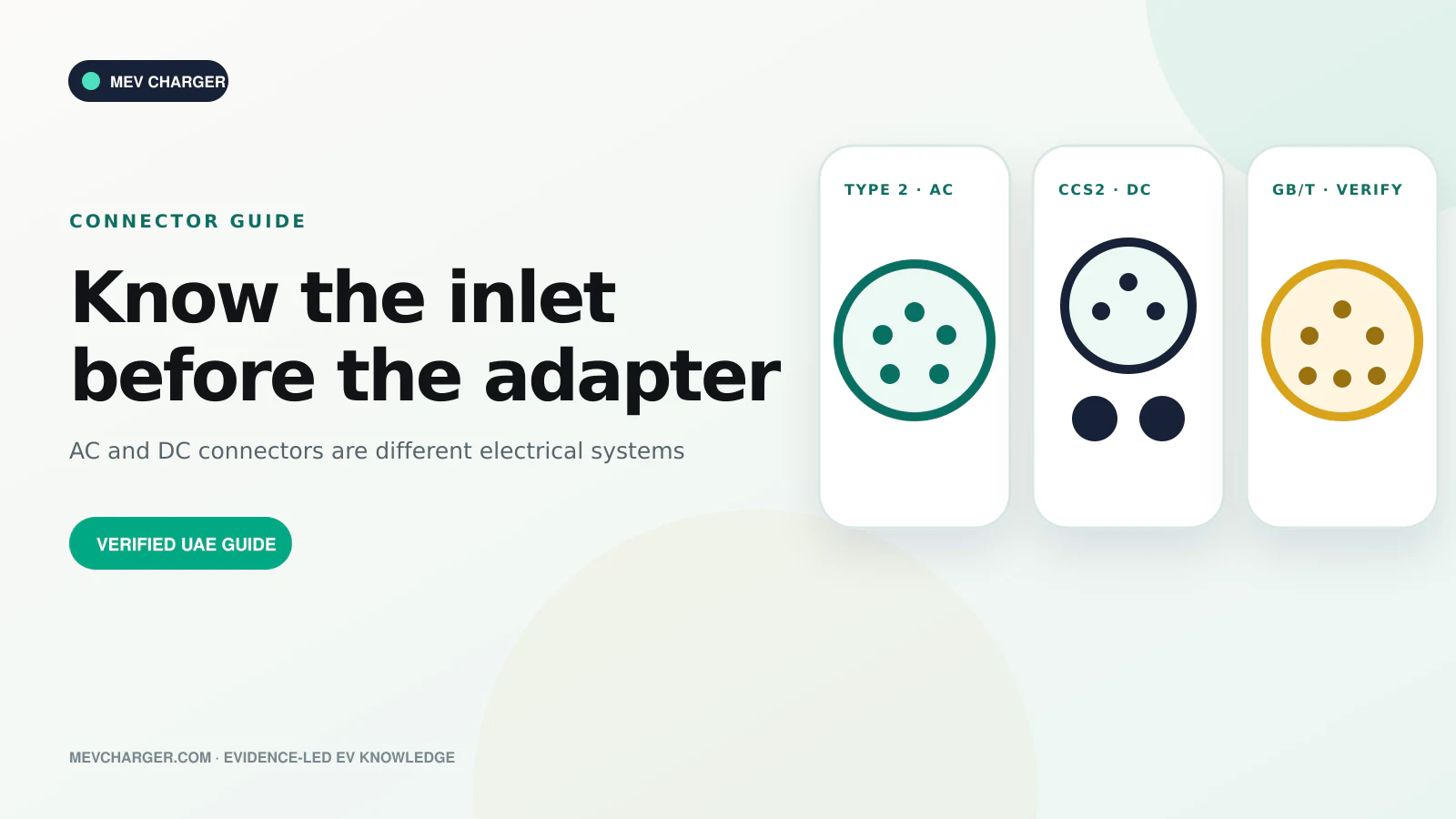
EV Charging Connectors in the UAE: AC, DC, Type 2, CCS2 and GB/T
Identify the correct charging port before buying a wallbox or adapter. This UAE guide explains AC versus DC, …

EV Charger Not Charging? A Safe UAE Troubleshooting Guide
A safety-first decision guide for a wallbox that is offline, slow, repeatedly stops or trips protection—witho…
Audi Q4 & Q8 e-tron Home Charging Guide UAE
Official Audi material shows why “e-tron” is not one charging specification: Q4 and Q8 limits vary by battery…
Tesla Model S & Model X Charging in UAE: GCC, Europe or US Import?
Current UAE pages publish up to 250 kW Supercharging, but model year, market and CCS equipment determine what…