
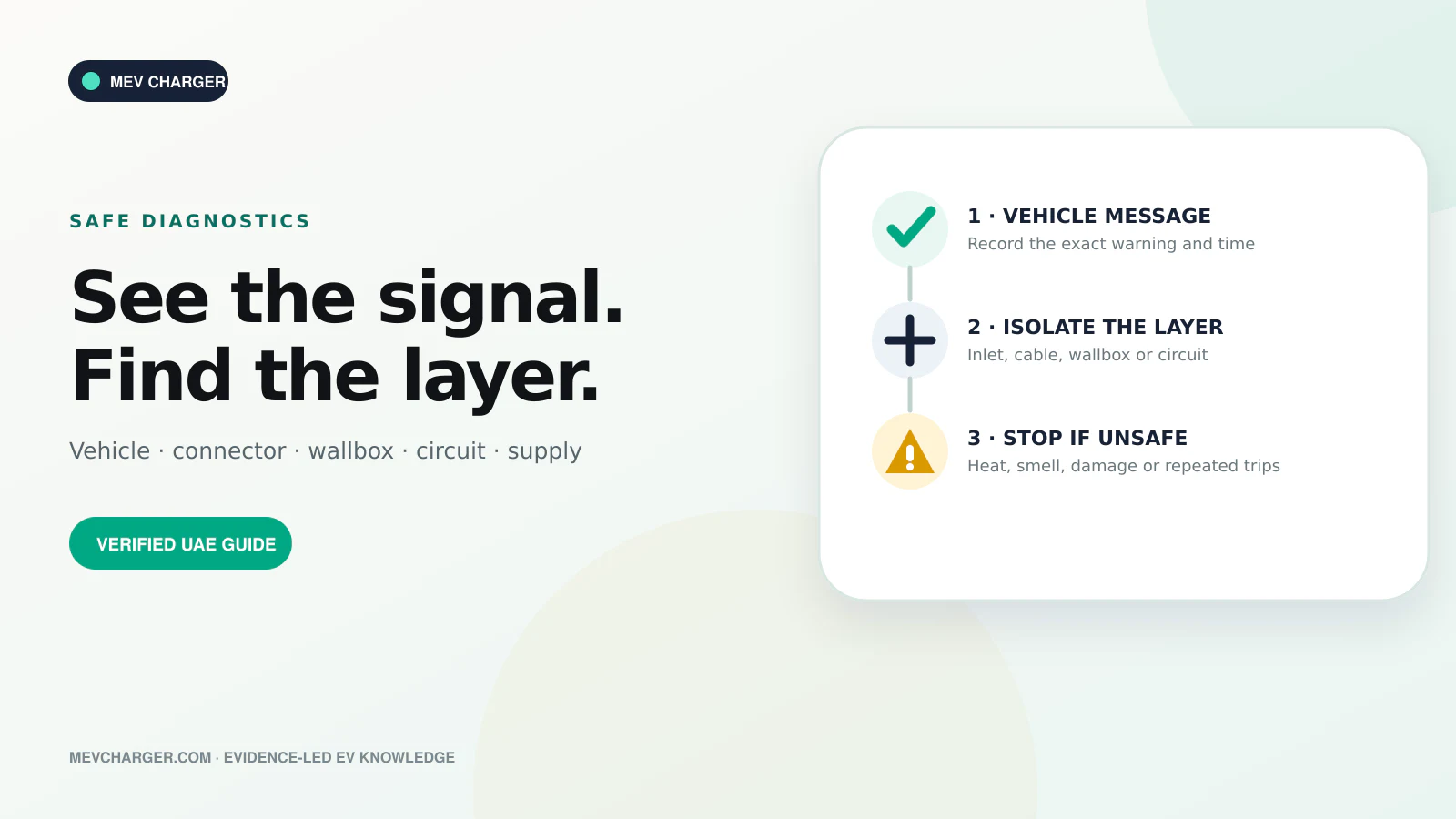
Start with safety, not resets. If there is smoke, a burning smell, visible melting, severe heat, water inside damaged equipment, arcing or repeated protective-device operation, stop using the charger and arrange qualified inspection. Do not open a distribution board or wallbox while energized.
First classify the symptom
| Symptom | Safe evidence to collect | Likely diagnostic branch |
|---|---|---|
| No lights or display | Photo of charger, visible isolator position and any outage affecting the property | Supply, isolation, upstream protection or charger power supply |
| Charger ready but car does not start | Vehicle screen, wallbox code, connector and charging schedule | Handshake, schedule, authorization, port or market-version mismatch |
| Starts then stops | Exact time, state of charge, temperature, code and whether protection operated | Thermal, communication, supply quality, protection or vehicle limit |
| Charges slowly | kW shown by car/app, battery percentage, phase supply and other active loads | Onboard limit, current setting, load management, temperature or phase loss |
| Breaker/RCD trips | Which device operated and at what point in the session | Electrical test required; repeated resetting is not a repair |
Safe checks the driver can perform
- Read and photograph the exact error on the car and charger before clearing it.
- Confirm the connector is fully seated and the inlet is free of visible debris or damage.
- Check the vehicle’s charging schedule, location-based schedule, current limit and target state of charge.
- If the wallbox needs app, RFID or network authorization, confirm that the session is actually authorized.
- Check whether load management or a solar mode is intentionally reducing current.
- Try a known-compatible public or portable charger only if it is safe and approved for the vehicle. This separates a vehicle-side issue from a fixed-installation issue.
Do not spray cleaner into the connector, force a lock, bridge a pilot contact, stack adapters or repeatedly reset a device that operates again.
Why a charger can be “slow” without being faulty
The wallbox rating is not the same as charging power. Actual AC power is limited by the lowest of the available supply, charger setting, cable/current capability, load-management command and vehicle onboard charger. Power may also reduce near the charging target or while the battery system manages temperature.
For example, a 22 kW wallbox can correctly show about 7 kW when connected to a car limited to single-phase 32 A. Compare the setup using the 7/11/22 kW guide before labelling it a fault.
When charging starts and repeatedly stops
Record whether the vehicle unlocks the plug, whether the wallbox returns to ready, and whether an electrical protective device operates. Those three outcomes lead to different tests. A technician may need to measure supply voltage under load, earth continuity and fault-loop conditions, insulation, residual-current behavior, phase presence, termination temperature and charger logs.
Imported cars and adapters
UAE parallel imports can add another failure layer: the connector may fit while signalling, software or the direction of adaptation is incompatible. Send the full inlet photo, vehicle-market label, adapter labels on both sides and charger model. Review the connector guide before purchasing another adapter.
If a breaker or residual-current device operates
Identify the exact device rather than calling every switch a breaker. Photograph the label and position. A single operation can still require investigation; repeated operation means the cause has not been removed. Never replace a protective device with a larger rating to keep the charger running.
The service report should close the loop
A useful report states the observed symptom, stored fault codes, tests performed, measured values, root cause, corrective action and final charging test. “Restarted and working” is not a root-cause report.
What to send MEV for faster diagnosis
Send one continuous video showing the wallbox, the error, the open vehicle inlet and the relevant panel from a safe distance; add the charger model, car model/year/market, time the fault occurs and whether another charger works. Use the installation and support planner to structure the case.
Official sources
Battery, connector and charging limits can vary by model year, trim and market. Confirm the exact vehicle before buying equipment.
- IEC 61851-1:2017 — EV conductive charging general requirements International scope and general requirements for AC/DC EV supply equipment.
- DEWA — Regulatory Framework for EV Charging Infrastructure Dubai regulatory and technical framework, CPO licensing scope and current official documents.
- U.S. DOE AFDC — Charging electric vehicles at home Authoritative home-charging overview and dedicated charging-equipment installation context.
Need a charger or installation?
Choose your vehicle or plan the installation.
FAQs
Why is my 22 kW wallbox charging at about 7 kW?
Should I keep resetting a breaker that trips during charging?
Why does charging stop at the same percentage?
Can an adapter cause intermittent charging?
What information helps a technician diagnose the fault?
Related Articles
EV Charger Installation in the UAE: The Complete Home Guide
A practical, evidence-led guide to choosing power, surveying the site, planning cable and protection, and ins…
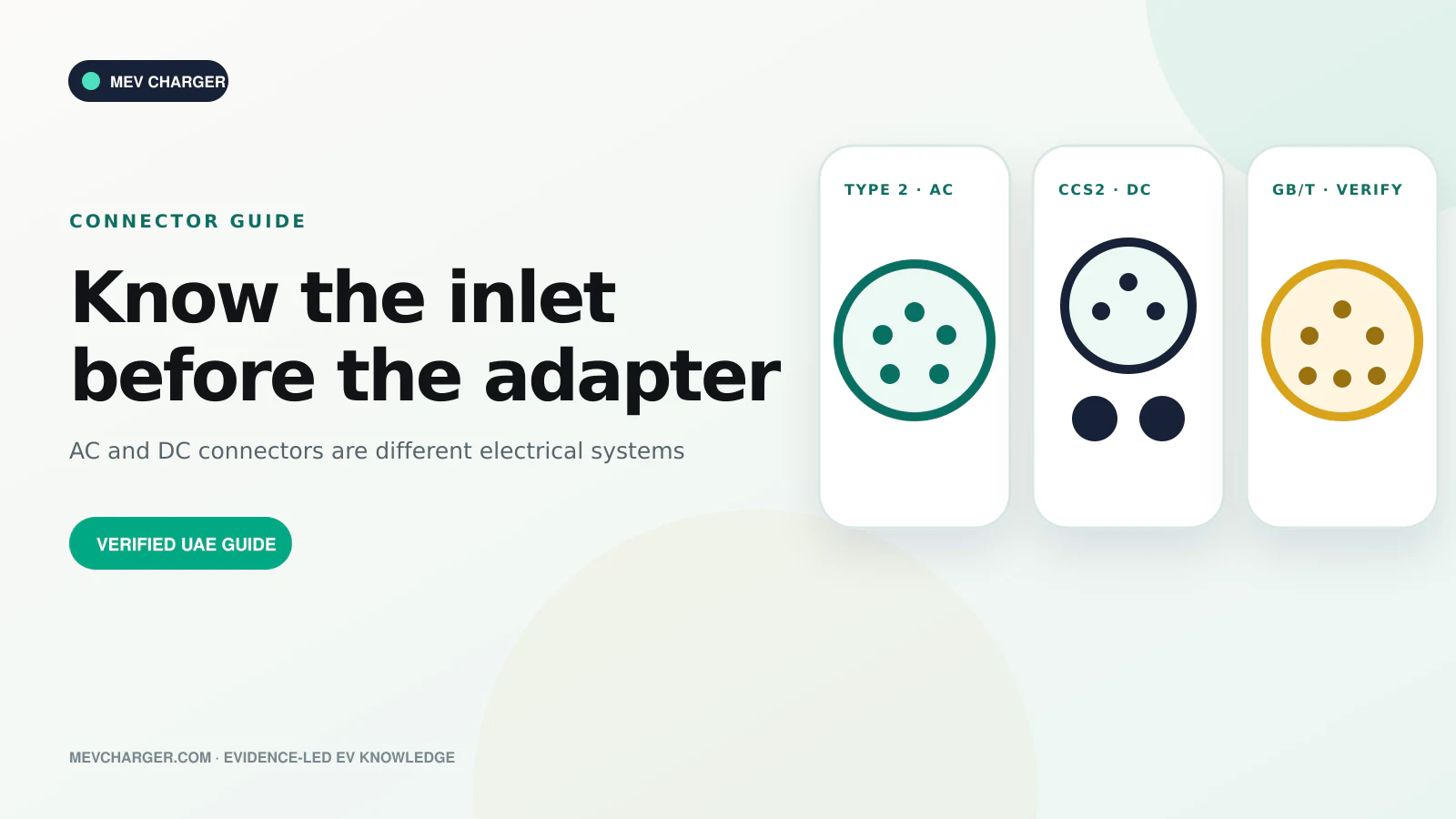
EV Charging Connectors in the UAE: AC, DC, Type 2, CCS2 and GB/T
Identify the correct charging port before buying a wallbox or adapter. This UAE guide explains AC versus DC, …
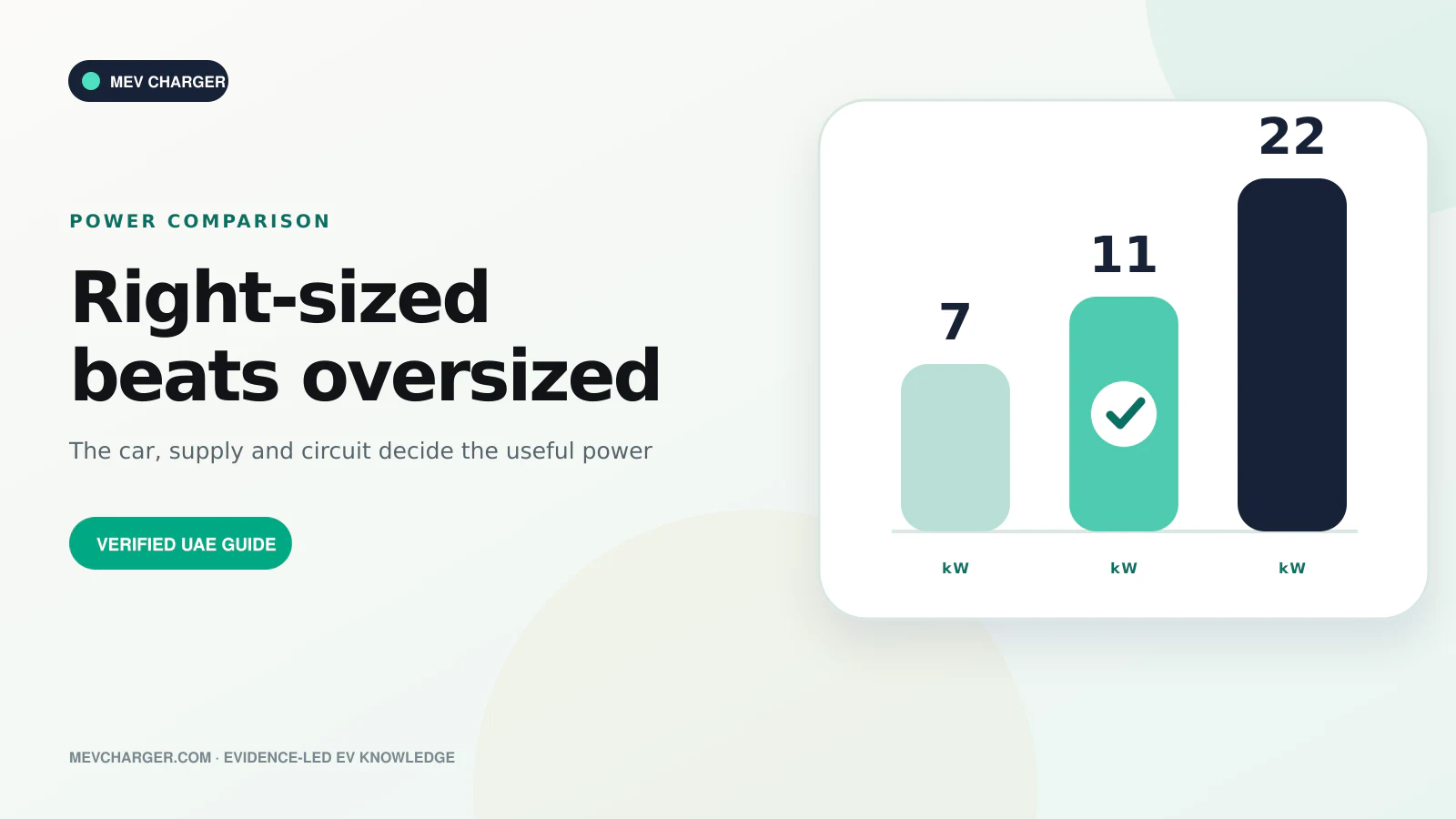
7 kW vs 11 kW vs 22 kW EV Chargers in the UAE
Choose charger power from the car, available phases and overnight energy need—not the largest number on the b…
Public EV Charging in the UAE: DEWA, UAEV and Trip Planning
Plan public charging by connector, live availability, payment access and a backup stop. Includes current offi…