
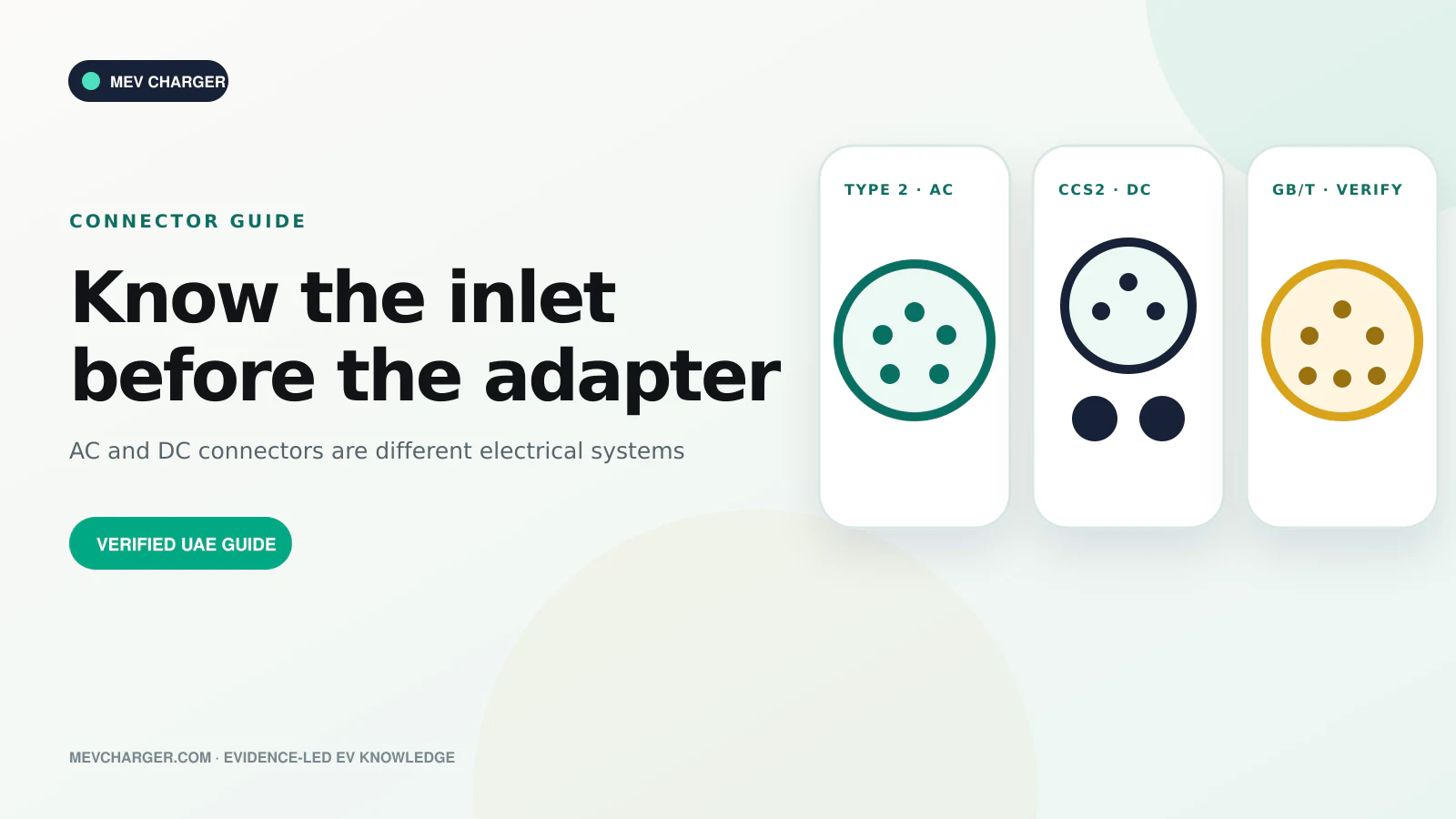
The rule that prevents most expensive mistakes: identify the physical inlet and the vehicle’s market version before choosing a charger. The model name alone is not enough in the UAE because GCC vehicles and parallel imports can use different interfaces.
AC charging and DC fast charging are different systems
With AC charging, the wallbox supplies alternating current and the car’s onboard charger converts it for the battery. Therefore, the onboard AC limit controls the actual speed. With DC charging, the station supplies controlled direct current to the vehicle’s high-voltage system; the vehicle and station negotiate power throughout the session.
| Question | AC home charging | DC public fast charging |
|---|---|---|
| Where is conversion performed? | Primarily by the vehicle’s onboard charger | Primarily by the off-board charging station |
| Main speed limit | Wallbox, supply and onboard AC limit | Vehicle curve, battery condition and station capability |
| Typical use | Overnight, workplace and destination charging | Long trips and quick top-ups |
| Can one rating predict the other? | No. A car with very fast DC charging may still have a modest AC limit. | |
What Type 2 and CCS2 mean
Type 2 is an AC vehicle-coupler configuration covered by the IEC 62196 family. CCS2 combines the Type 2 AC contact area with additional DC contacts for compatible fast charging. A CCS2 inlet can therefore visually include an upper Type 2-shaped section and two larger DC contacts below it.
Do not infer connector support from a dealer photo that shows only a closed flap. The full inlet must be photographed with every inner cover open.
What GB/T means for imported cars
GB/T is used on many China-market vehicles, with separate physical arrangements for AC and DC. A vehicle advertised under the same model name may use a different inlet when officially configured for another market. That is why “Chinese brand” does not automatically mean GB/T, and “sold in the UAE” does not automatically mean Type 2/CCS2.
Quick identification table
| Interface | Charging role | UAE buying check |
|---|---|---|
| Type 2 | AC | Confirm onboard AC power and whether the car needs a tethered cable or socketed wallbox. |
| CCS2 | DC, with Type 2 AC section in the combined inlet | Confirm the exact market vehicle and the public station connector. |
| GB/T AC | AC | Common on some China imports; confirm communication and rated current, not shape alone. |
| GB/T DC | DC | Separate from GB/T AC; adapter compatibility is vehicle- and station-dependent. |
| Type 1 / J1772 | AC | May appear on some older or imported vehicles; inspect the actual inlet. |
| NACS / Tesla North America | AC and DC on compatible North-American vehicles | Do not confuse a US import with a GCC Tesla that uses a different inlet. |
An adapter is not only a piece of metal
Mechanical fit does not prove charging compatibility. AC and especially DC charging also involve signalling, locking, temperature monitoring, current and voltage limits, and vehicle software. A DC adapter must be explicitly compatible with the exact vehicle, charging station and direction of conversion. Never stack adapters or defeat an inlet lock.
Five photos that identify the correct setup
- The complete open inlet from straight in front.
- Every AC/DC inner cap open.
- The vehicle identification or market label without exposing private owner data.
- The charger rating label.
- The connector head from the pin side and its rating label.
How to choose the charger after identifying the port
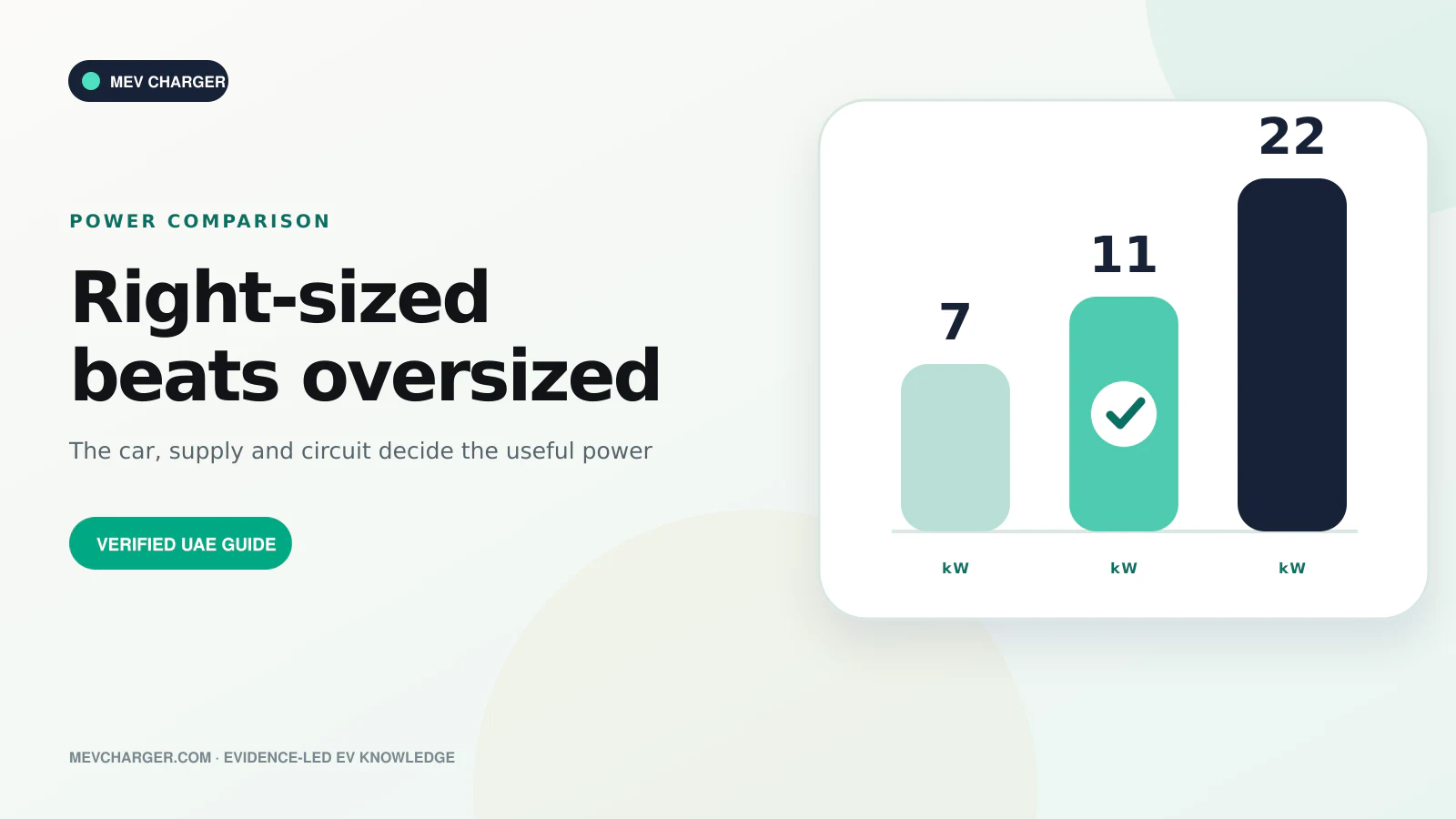
Port shape answers only the first question. Next confirm the car’s onboard AC limit, single- or three-phase support, daily distance, parking duration and property capacity. Then compare 7, 11 and 22 kW chargers and complete a site survey through the installation planner.
Practical UAE rule for parallel imports
If the official GCC specification and the actual car disagree, trust the physical vehicle, its rating label and its correct manual—not a listing copied from another market. Record the result in the customer report so future charger or adapter purchases use the same verified identity.
Official sources
Battery, connector and charging limits can vary by model year, trim and market. Confirm the exact vehicle before buying equipment.
- IEC 61851-1:2017 — EV conductive charging general requirements International scope and general requirements for AC/DC EV supply equipment.
- IEC 62196-1:2025 — EV plugs, inlets and cable assemblies International scope for EV plugs, socket-outlets, vehicle connectors, inlets and cable assemblies.
- IEC 62196-2:2025 — AC dimensional compatibility Standardized AC vehicle connector and inlet configurations, voltage and current scope.
- IEC 62196-3:2026 — DC vehicle couplers Standardized DC vehicle coupler configurations for conductive charging systems.
- DEWA — EV charger types and instructions Official public charger types and operating instructions in Dubai.
Need a charger or installation?
Choose your vehicle or plan the installation.
FAQs
Is Type 2 the same as CCS2?
Do all Chinese electric cars use GB/T?
Can a Type 2 to GB/T adapter work with every car?
Can an AC adapter be used for DC fast charging?
What is the safest way to identify my car port?
Related Articles
EV Charger Installation in the UAE: The Complete Home Guide
A practical, evidence-led guide to choosing power, surveying the site, planning cable and protection, and ins…
7 kW vs 11 kW vs 22 kW EV Chargers in the UAE
Choose charger power from the car, available phases and overnight energy need—not the largest number on the b…

Public EV Charging in the UAE: DEWA, UAEV and Trip Planning
Plan public charging by connector, live availability, payment access and a backup stop. Includes current offi…
EV Charger Not Charging? A Safe UAE Troubleshooting Guide
A safety-first decision guide for a wallbox that is offline, slow, repeatedly stops or trips protection—witho…
Imported EV Charging Port Check UAE: Photo & Version Guide
A no-guess workflow for parallel-import EVs: the six photos and vehicle details needed before choosing Type 2…
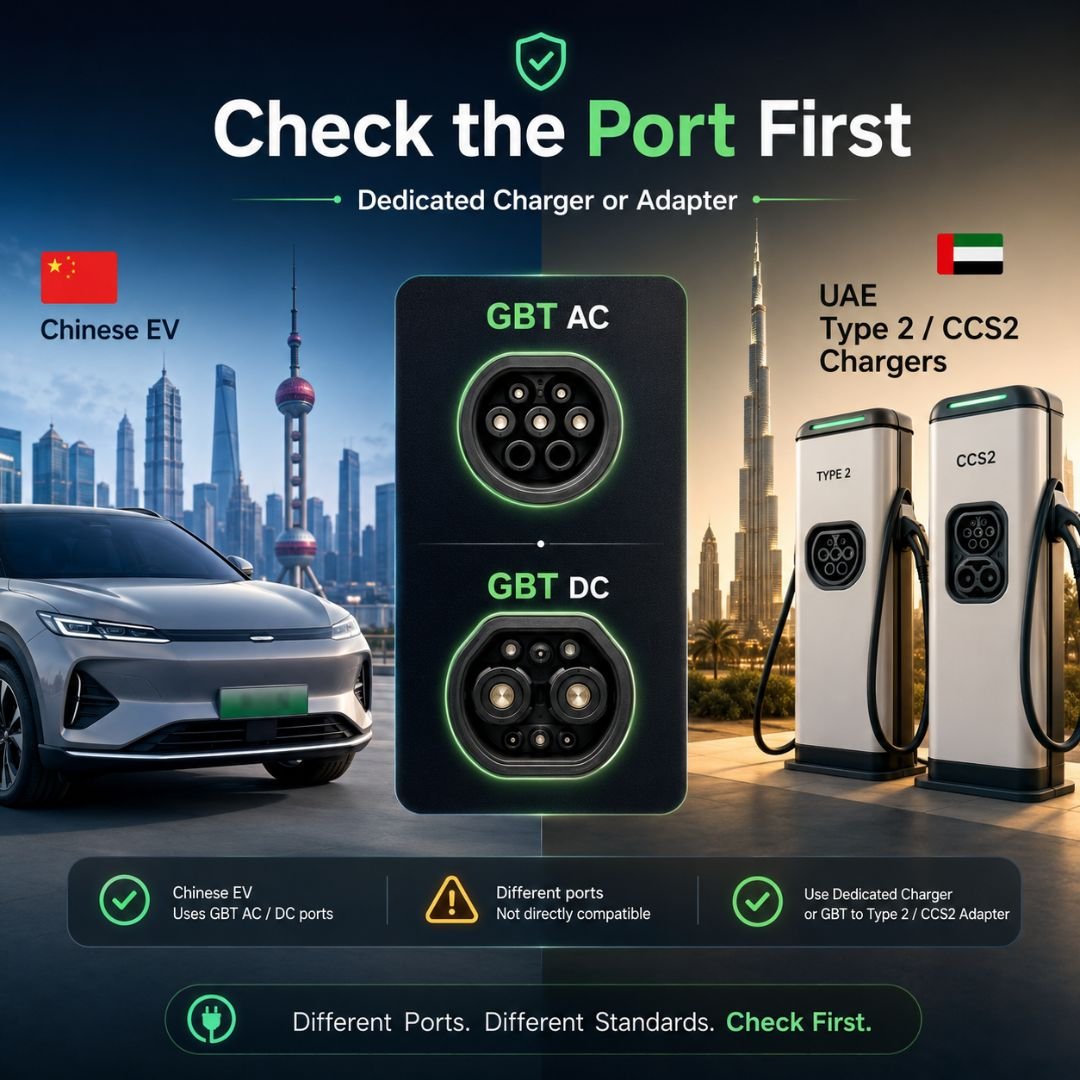
GBT Charger Guide for Chinese EVs in UAE
A practical UAE guide to GBT AC and GBT DC charging for Chinese-imported EVs, including chargers, adapters an…