
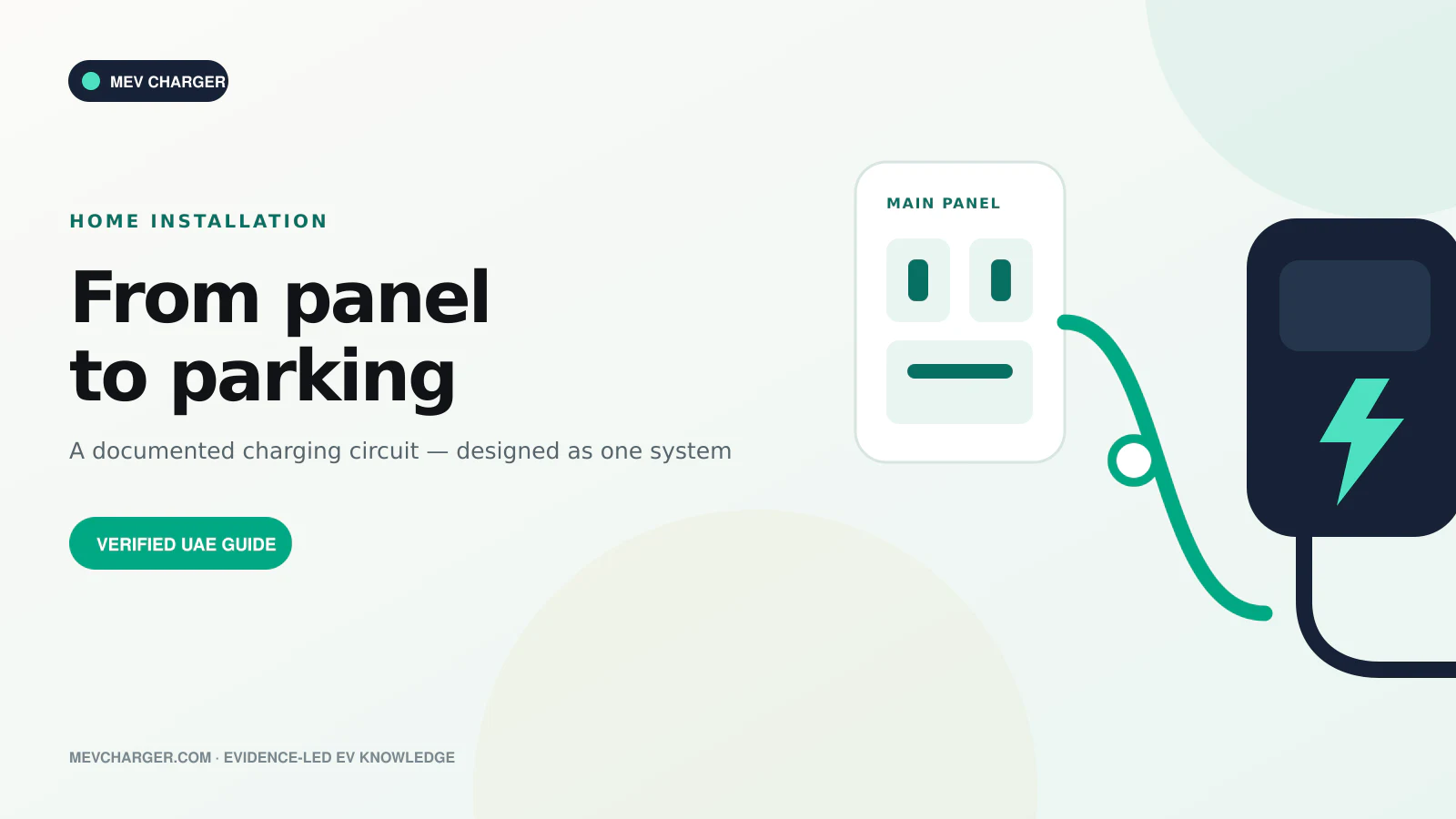
Short answer: a safe installation starts with the exact car and its charging port, then the available electrical supply, and only then the wallbox. Buying a 22 kW charger first does not guarantee 22 kW charging.
The correct installation sequence
| Stage | What must be confirmed | Why it matters |
|---|---|---|
| 1. Vehicle | Market version, inlet and onboard AC limit | The car—not the wallbox—sets the maximum AC power it can accept. |
| 2. Property | Villa, apartment, office or shared parking | Access, approvals and the cable route change by property type. |
| 3. Supply | Single-phase or three-phase, spare capacity and panel condition | This determines the realistic charger size and whether load management is needed. |
| 4. Route | Distance, containment, outdoor exposure and any civil work | Cable design and quotation depend on the real route, not straight-line distance. |
| 5. Protection | Dedicated circuit, isolation, residual-current protection and earthing | Protection must match the charger instructions and the applicable authority requirements. |
| 6. Handover | Electrical tests, charging test, app setup and labels | A powered wallbox is not a completed installation until it is tested. |
Should you choose 7 kW, 11 kW or 22 kW?
Nominal power is only one part of the decision. Around 7 kW is commonly associated with a 32 A single-phase circuit. Around 11 kW normally uses 16 A per phase on a three-phase supply, while 22 kW normally uses 32 A per phase. These are nominal electrical relationships; actual delivered power and energy vary.
- 7 kW: often enough for overnight charging and cars with a single-phase onboard charger.
- 11 kW: a strong three-phase choice when the vehicle supports it and the property has capacity.
- 22 kW: useful only when the car can accept it, or for a site strategy that justifies the extra connected load.
Use the detailed 7 vs 11 vs 22 kW comparison before selecting equipment.
What the site survey should record
A professional survey should photograph the main distribution board, meter area, proposed charger position, full cable route and the vehicle inlet. It should also record the main breaker, phase arrangement, existing large loads, earthing observations, route length, wall penetrations, outdoor exposure and whether trenching or interlock removal is required.
Distance alone is not a cable specification. Conductor size must be checked against current, installation method, route length, grouping, ambient conditions, voltage drop and the charger manufacturer’s instructions. This is especially important in UAE heat and in enclosed or sun-exposed routes.
Protection and isolation are design items
An EV charger should be supplied by an appropriately designed dedicated circuit. The exact breaker and residual-current protection arrangement depends on the wallbox’s built-in protection, manufacturer instructions and the applicable technical rules. An isolator may also be required or selected for safe local isolation. Earthing must be verified by measurement; visual appearance is not enough.
Do not treat a breaker marked “EV” as proof that the circuit is suitable. The cable, terminations, protection coordination and earth path must work as one system.
Villa, apartment and commercial installation
Villa
The route is usually under one customer’s control, but spare electrical capacity, outdoor containment and civil work still need inspection. A neat short route is preferable to unnecessary cable length.
Apartment or shared parking
Confirm the parking bay, source meter, building-management process, common-area route and how energy will be attributed. Never assume a nearby socket belongs to the apartment or can sustain continuous EV charging.
Office or multi-charger site
Simultaneous demand becomes the main question. Dynamic load management can allocate available power, but it must be engineered and accepted for the site; it is not a substitute for an inadequate installation.
What should be included in a professional quotation?
- Exact charger model, connector and rated output.
- Surveyed cable-route length and route type.
- Cable, containment, breaker, residual-current protection and isolator scope.
- Civil work such as interlock trenching shown separately.
- Testing, commissioning, app connection and user handover.
- Clear exclusions: authority fees, building approvals or load upgrades if not included.
Before booking the installation
Prepare four items: a photo of the open vehicle charging inlet, the car model year or VIN-market information, a clear photo of the main board, and a video from the board to the parking bay. You can then use the MEV installation planner to receive a structured preliminary report before the technician confirms the final design on site.
Official sources
Battery, connector and charging limits can vary by model year, trim and market. Confirm the exact vehicle before buying equipment.
- DEWA — Regulatory Framework for EV Charging Infrastructure Dubai regulatory and technical framework, CPO licensing scope and current official documents.
- IEC 61851-1:2017 — EV conductive charging general requirements International scope and general requirements for AC/DC EV supply equipment.
- U.S. DOE AFDC — Charging electric vehicles at home Authoritative home-charging overview and dedicated charging-equipment installation context.
Need a charger or installation?
Choose your vehicle or plan the installation.
FAQs
Can I install a 22 kW charger on single-phase power?
Does a bigger wallbox always charge the car faster?
Is cable size determined only by charger power?
Do apartment installations need a site check?
What proves the installation is complete?
Related Articles

7 kW vs 11 kW vs 22 kW EV Chargers in the UAE
Choose charger power from the car, available phases and overnight energy need—not the largest number on the b…
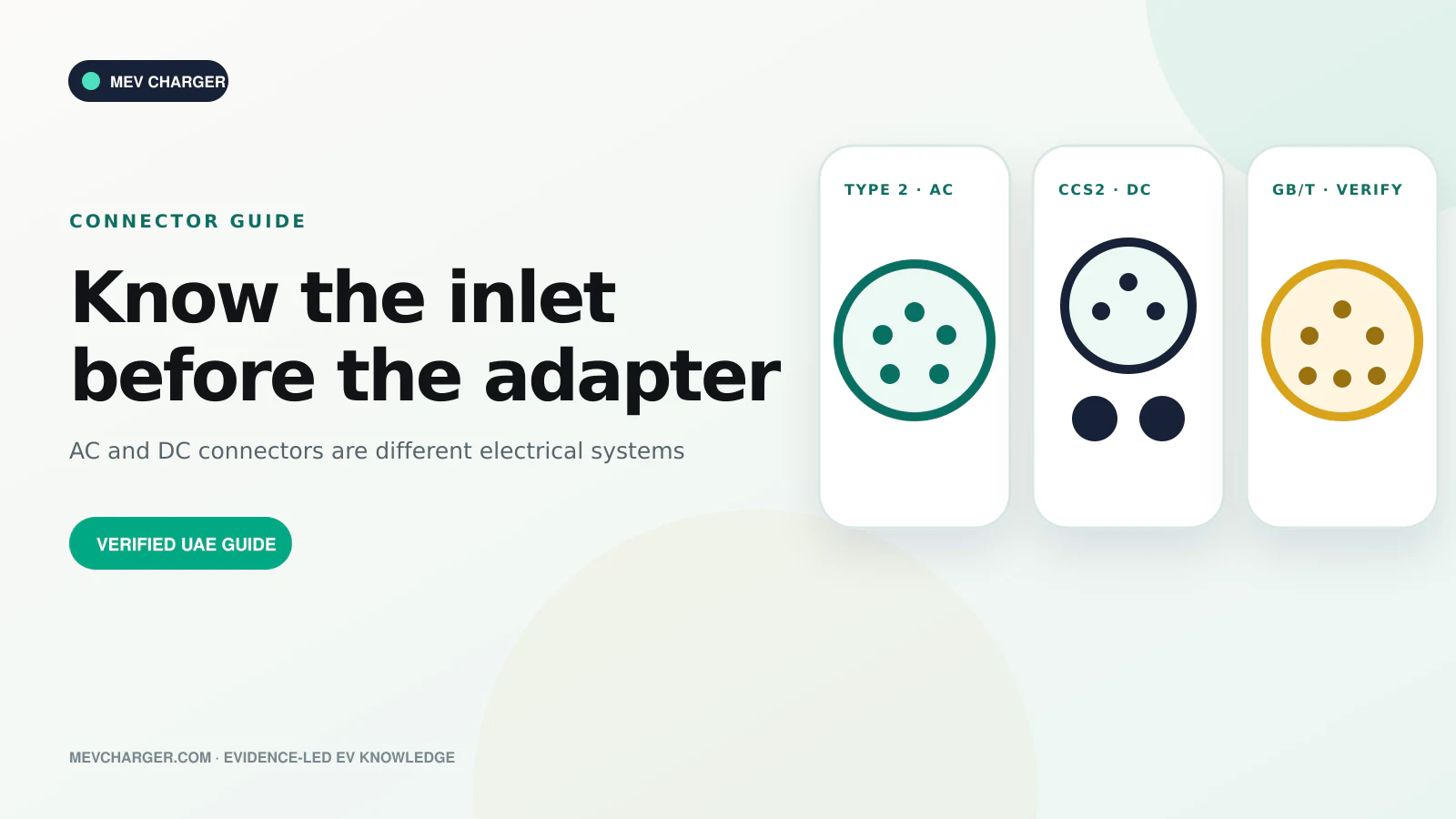
EV Charging Connectors in the UAE: AC, DC, Type 2, CCS2 and GB/T
Identify the correct charging port before buying a wallbox or adapter. This UAE guide explains AC versus DC, …
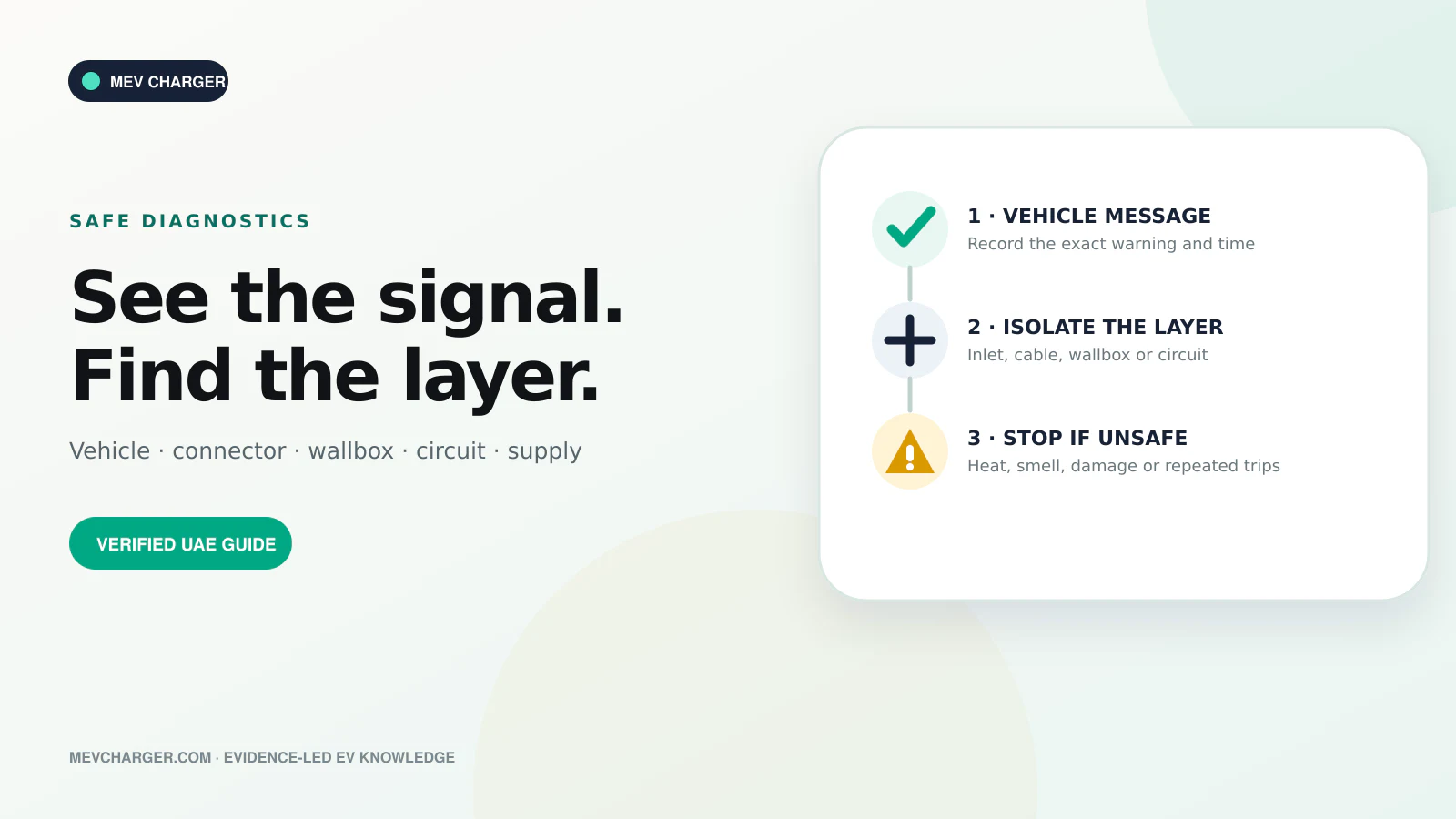
EV Charger Not Charging? A Safe UAE Troubleshooting Guide
A safety-first decision guide for a wallbox that is offline, slow, repeatedly stops or trips protection—witho…
Home EV Charging Cost in the UAE: A Calculator You Can Verify
Calculate charging cost from the energy added, charging losses and your actual electricity tariff—and avoid c…
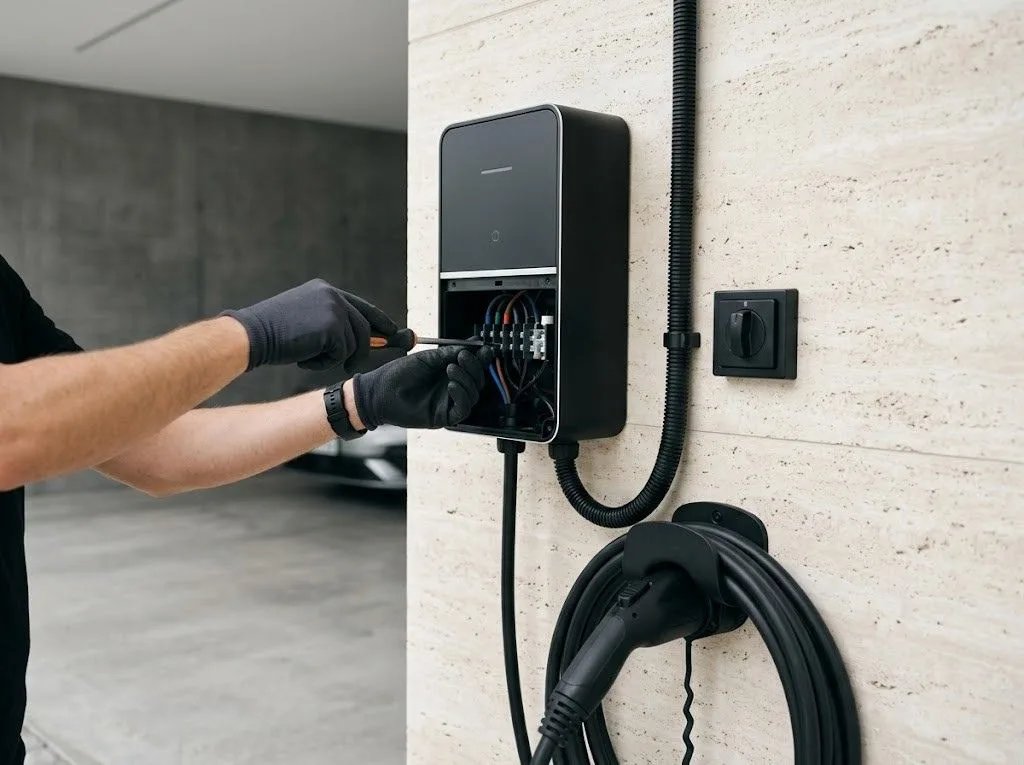
EV Charger Approval in the UAE: Villas, Apartments and Buildings
A practical, authority-aware guide to the permissions, electrical checks and documents to confirm before inst…
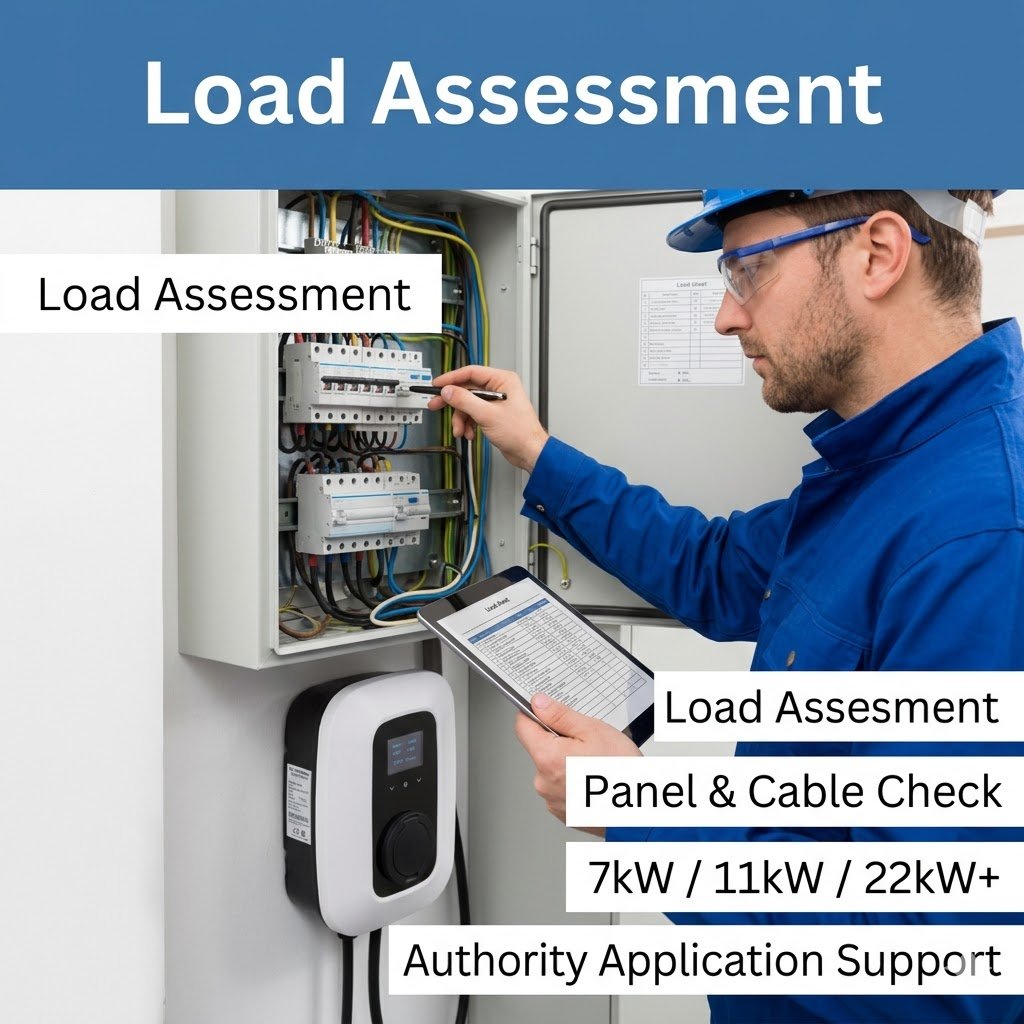
EV Charger Load Certificate & Load Increase Study in UAE
Professional EV charger load assessment in the UAE, including site inspection, load calculation, panel and ca…