
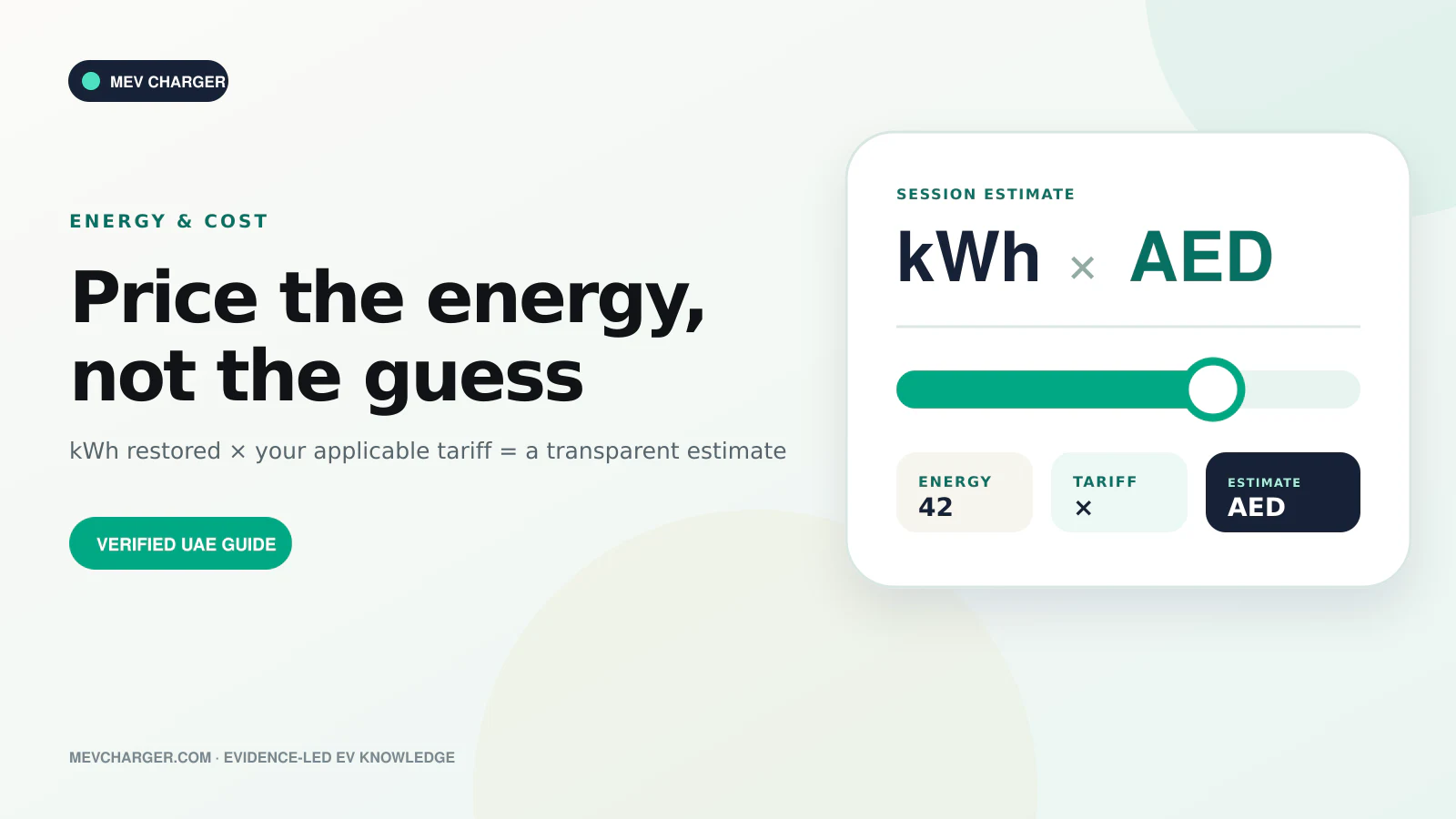
The useful formula is simple: cost equals energy measured at the supply multiplied by the tariff that applies to that supply. Battery capacity alone is not the billed energy, and a public charging tariff is not automatically your home tariff.
The three numbers you need
- Energy added to the battery: battery capacity multiplied by the percentage added.
- Charging efficiency assumption: use metered charger data when available; otherwise use a clearly labelled estimate.
- Your applicable tariff: read the electricity bill or the public-network app for that session.
Estimated supply energy = battery energy added ÷ assumed efficiency.
Estimated cost = supply energy × tariff per kWh.
Worked example with transparent assumptions
Suppose a car receives 50 kWh into the battery. If the calculation assumes 90% wall-to-battery efficiency, the supply would deliver approximately 55.6 kWh: 50 ÷ 0.90. Multiply 55.6 by the tariff that applies to your account. The 90% figure is an engineering assumption for the example, not a universal promise; the charger meter or utility meter is better evidence.
| Battery energy added | Assumed efficiency | Estimated metered energy |
|---|---|---|
| 20 kWh | 90% | 22.2 kWh |
| 40 kWh | 90% | 44.4 kWh |
| 50 kWh | 90% | 55.6 kWh |
| 70 kWh | 90% | 77.8 kWh |
Dubai public charging rates are not home rates
DEWA’s current consumer FAQ states that, from 30 September 2024, registered EV Green Charger users are charged AED 0.70/kWh plus VAT for public AC charging and AED 1.20/kWh plus VAT for public DC charging. These are official Dubai public-network rates at the review date. They should not be copied into a home-cost calculator or assumed for another operator or emirate.
Public prices, parking fees, subscriptions or promotions can change. Always check the live provider screen before starting the session.
How to calculate a home session correctly
- Use the marginal electricity tariff shown on the account, including any applicable adjustment or surcharge.
- If the wallbox reports delivered kWh, multiply that value by the tariff.
- If only battery percentage is known, calculate a range because the displayed percentage and usable capacity may not equal the nominal battery label.
- Do not add the full battery capacity for a 20% to 80% session; only 60% of the relevant usable energy is being added, before losses.
Charging power changes time, not necessarily energy cost
A 7 kW and an 11 kW wallbox can deliver roughly the same energy for the same battery increase; the higher-power unit usually completes it sooner. Cost may differ slightly because efficiency, thermal management, standby consumption and tariff timing can differ, but multiplying wallbox power by the advertised battery capacity is not a cost calculation.
Why real sessions differ
Battery temperature, cabin pre-conditioning, battery balancing near full charge, cable and conversion losses, charger standby load and the car’s state of charge all affect measured energy and time. UAE heat can also make cooling energy more visible in some sessions.
A better monthly estimate
Use driving energy rather than “number of full charges.” Multiply monthly distance by the car’s observed kWh/100 km, divide by 100, then divide by measured or assumed charging efficiency. Finally multiply by the applicable tariff. Recalculate from two or three actual wallbox-meter readings after installation.
Turn the estimate into an installation decision
Cost does not decide charger size by itself. The car’s onboard limit, nightly parking window and property capacity do. Compare 7, 11 and 22 kW, then use the MEV installation planner for a route and equipment estimate.
Official sources
Battery, connector and charging limits can vary by model year, trim and market. Confirm the exact vehicle before buying equipment.
- DEWA — Consumer FAQ: EV Green Charger Current public Green Charger AC/DC tariffs, account and billing information in Dubai.
- U.S. DOE AFDC — Charging electric vehicles at home Authoritative home-charging overview and dedicated charging-equipment installation context.
- U.S. DOE AFDC — Electric vehicle charging stations Authoritative explanation of AC charging equipment and DC fast charging.
Need a charger or installation?
Choose your vehicle or plan the installation.
FAQs
What is the current DEWA public EV charging rate?
Can I use the DEWA public rate to calculate home charging?
Why is metered energy higher than battery energy added?
Does an 11 kW charger cost more per charge than a 7 kW charger?
What is the best data for an accurate monthly estimate?
Related Articles
Public EV Charging in the UAE: DEWA, UAEV and Trip Planning
Plan public charging by connector, live availability, payment access and a backup stop. Includes current offi…
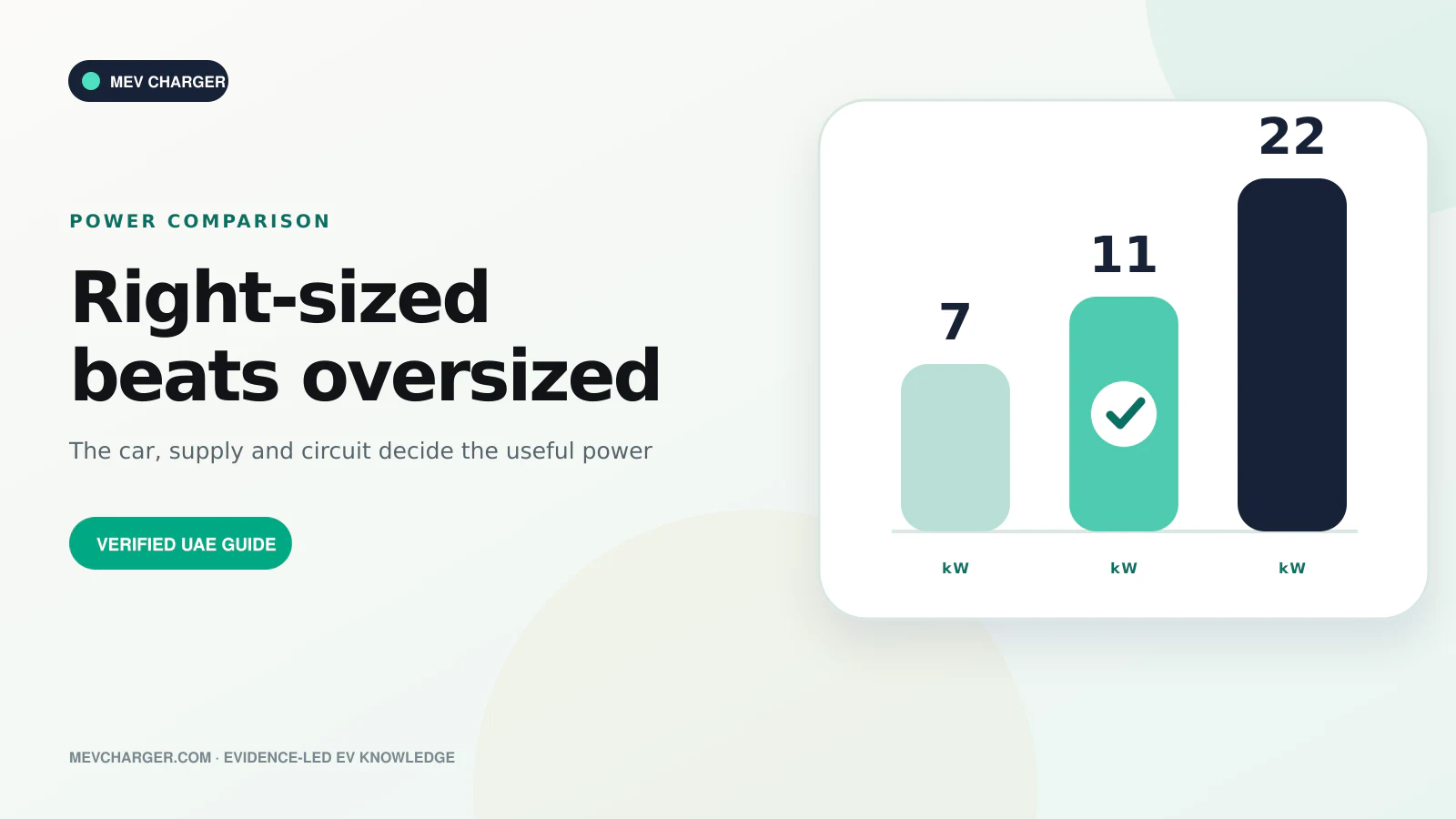
7 kW vs 11 kW vs 22 kW EV Chargers in the UAE
Choose charger power from the car, available phases and overnight energy need—not the largest number on the b…
EV Charger Installation in the UAE: The Complete Home Guide
A practical, evidence-led guide to choosing power, surveying the site, planning cable and protection, and ins…
EV Charging Connectors in the UAE: AC, DC, Type 2, CCS2 and GB/T
Identify the correct charging port before buying a wallbox or adapter. This UAE guide explains AC versus DC, …
GBT Charger Guide for Chinese EVs in UAE
A practical UAE guide to GBT AC and GBT DC charging for Chinese-imported EVs, including chargers, adapters an…
ROX 01 Charging Guide in UAE
ROX 01 charging in the UAE: 56.01kWh battery, 7kW AC, Type 2 / CCS2 GCC versions and GBT China imports.