
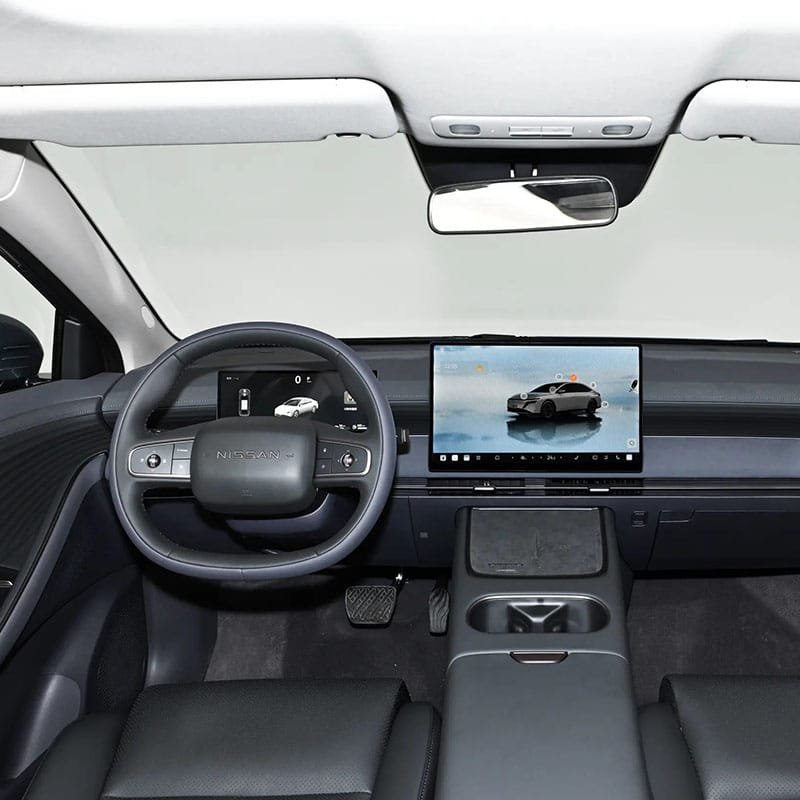
Decision first: do not buy a Nissan N6 charger from the model name alone. Nissan's official launch material presents the N6 as a China-market plug-in hybrid and does not publish the UAE connector, onboard AC limit or a UAE charging specification. In the UAE, the correct solution starts with the actual car.
What Nissan officially confirms
| Item | Official information | How MEV uses it |
|---|---|---|
| Market | Launched by Dongfeng Nissan in China | Treat a UAE car as an imported-market case until its documents prove otherwise. |
| Powertrain | Plug-in hybrid with a 1.5-litre engine | The car can be charged, but the PHEV identity does not reveal its connector. |
| Battery | 21.1 kWh LFP | Useful for energy planning; it does not determine wallbox power. |
| Grades | 180 Air, 180 Pro, 180 Max, 180 Max+ and 170 Max+ | Record the exact grade and model year before using a specification. |
| EV range | Maximum claim of 180 km | The release does not present this as a UAE or WLTP result; do not turn it into a local promise. |
| Rapid charging | Nissan says under 20 minutes | No start/end percentage, power or UAE connector is stated on the reviewed page, so it cannot select a home charger. |
The three missing facts that control charger choice
The official release reviewed here does not state the physical AC inlet, DC interface or onboard AC input limit. Those are the exact facts that determine whether a cable fits, whether signalling is compatible and how much AC power the car can accept. A marketplace listing that says “for Nissan N6” is not enough evidence.
- Connector: photograph the complete open inlet straight on, with every lower or inner cover open.
- Market identity: record the VIN/vehicle label, grade, model year and the language/market of the owner's documentation.
- Charging limits: locate the AC voltage, phase/current or kW limit in the manual, charging screen or official vehicle specification supplied with that car.
Type 2, GB/T or adapter?
Do not choose among Type 2, GB/T or an adapter from the brand name. The connector must be identified physically and the direction of any adapter must match the source charger and the vehicle inlet. Mechanical fit alone does not prove correct control signalling, locking, temperature monitoring or DC compatibility.
If the car arrived with a portable charger, photograph both sides of its rating label and both plugs. That label may help identify the intended supply, but it still does not replace a check of the vehicle's maximum AC input.
How to choose home-charging power without guessing
| Verified result from the car | What it may support | Installation decision |
|---|---|---|
| Single-phase, around 16 A | Approximately 3.7 kW nominal | A higher-rated wallbox can be limited, but will not make this car accept more. |
| Single-phase, around 32 A | Approximately 7.4 kW nominal | Check available load, route and protection before selecting the circuit. |
| Three-phase input is explicitly confirmed | Power depends on the documented per-phase current | Only then compare an 11 or 22 kW three-phase wallbox with the car limit. |
| No reliable AC figure | Unknown | Pause equipment purchase and request the exact manual/specification or a supervised compatibility test. |
The power figures above are electrical relationships, not Nissan N6 specifications. Read the 7, 11 and 22 kW comparison only after the vehicle limit is known.
How to estimate charging time honestly
Use the official 21.1 kWh nominal battery figure only as a planning reference. Estimated source energy equals the battery energy you intend to add divided by measured or assumed charging efficiency. Estimated time then equals source energy divided by the actual sustained AC power shown by the car or meter.
For example, moving through 60 percentage points represents about 12.7 kWh of nominal battery energy before losses: 21.1 × 0.60. The result is not a promise because usable capacity, temperature, balancing, auxiliary loads and the real onboard limit change the session. Do not use Nissan's “under 20 minutes” rapid-charging statement as a home-AC time.
UAE installation checklist
- Open-inlet photo and close-up of any symbols or labels.
- Vehicle VIN/market label, grade and model year.
- Main distribution-board photo with the main rating visible from a safe distance.
- Continuous route video from the board to the parking position.
- Approximate route length and any interlock, wall penetration or outdoor exposure.
- Whether a cable, isolator or protective device is already installed—existing equipment must still be tested, not assumed suitable.
Cable and protection design depends on current, route, installation method, grouping, temperature, voltage drop, charger instructions and measured earthing. A fixed cable size copied from another villa is not a professional design.
Best next step for an N6 owner
Upload the inlet, vehicle label, electrical board and route through the MEV installation planner. The preliminary report should state what is verified, what is still conditional, the compatible charger category and the work included. Final approval remains subject to the technician's measurements and charging test.
Official sources
Battery, connector and charging limits can vary by model year, trim and market. Confirm the exact vehicle before buying equipment.
- Nissan Global Newsroom — Nissan launches all-new N6 in China China launch, PHEV identity, five grades, 1.5-litre engine, 21.1 kWh LFP battery, maximum 180 km EV claim and rapid-charging claim without UAE connector or onboard-AC data.
- IEC 62196-2:2025 — AC vehicle couplers Standardized AC connector and inlet configurations. A standard connector family does not prove compatibility with an unverified imported vehicle.
- DEWA — Regulatory Framework for EV Charging Infrastructure Official Dubai regulatory and technical framework context for EV charging infrastructure. Final installation requirements remain site- and equipment-specific.
- Nissan official UAE/global source Vehicle identity and UAE/market status. Article-specific figures still require editorial fact checking.
Need a charger or installation?
Choose your vehicle or plan the installation.
FAQs
Does Nissan N6 definitely use Type 2 in the UAE?
What battery does the Nissan N6 have?
Can Nissan N6 charge in under 20 minutes?
Should I buy a 7 kW, 11 kW or 22 kW wallbox for N6?
What should I send for a Nissan N6 installation quote?
Related Articles
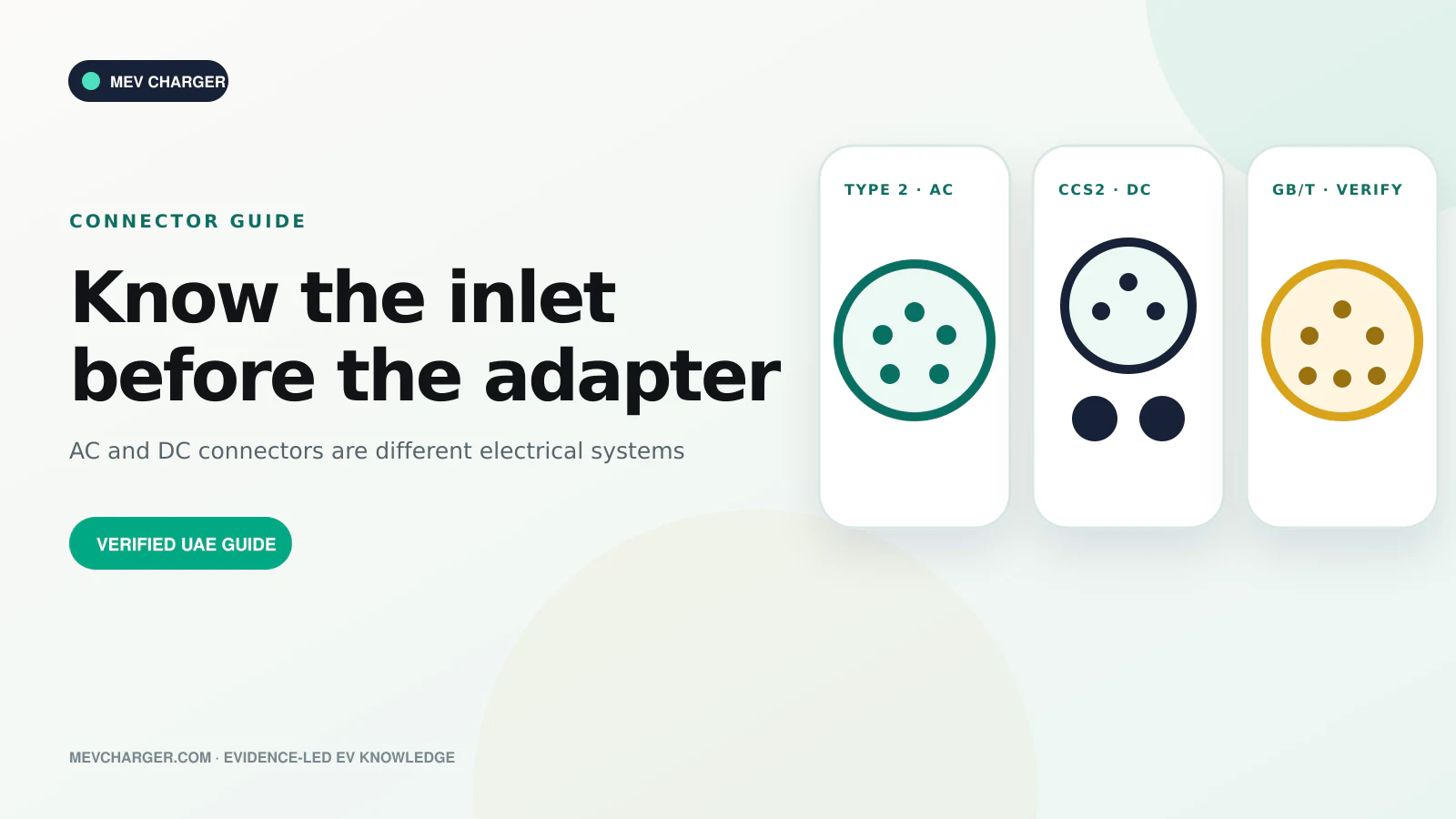
EV Charging Connectors in the UAE: AC, DC, Type 2, CCS2 and GB/T
Identify the correct charging port before buying a wallbox or adapter. This UAE guide explains AC versus DC, …
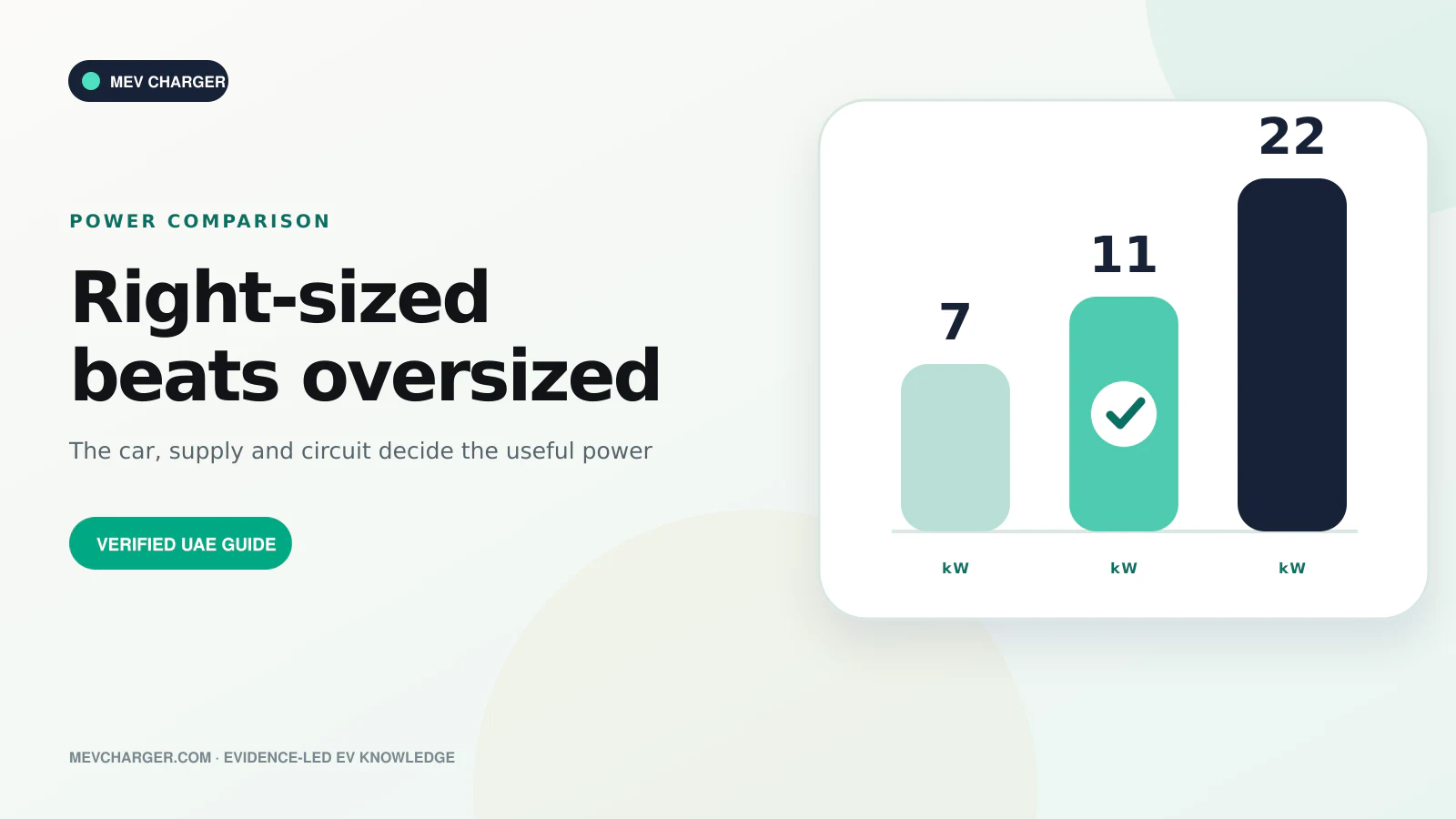
7 kW vs 11 kW vs 22 kW EV Chargers in the UAE
Choose charger power from the car, available phases and overnight energy need—not the largest number on the b…
EV Charger Installation in the UAE: The Complete Home Guide
A practical, evidence-led guide to choosing power, surveying the site, planning cable and protection, and ins…
EV Charger Not Charging? A Safe UAE Troubleshooting Guide
A safety-first decision guide for a wallbox that is offline, slow, repeatedly stops or trips protection—witho…
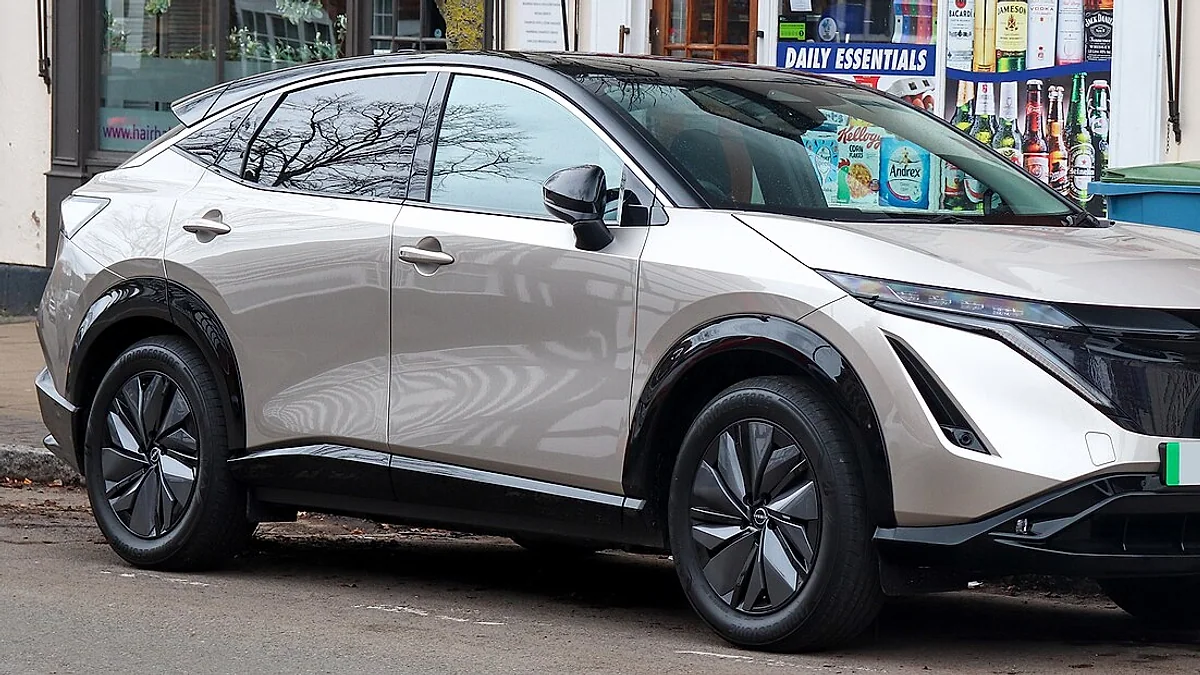
Nissan ARIYA Charger Guide UAE: Market Version First
A source-led ARIYA guide for UAE owners covering European CCS evidence, changing AC capability by version and…
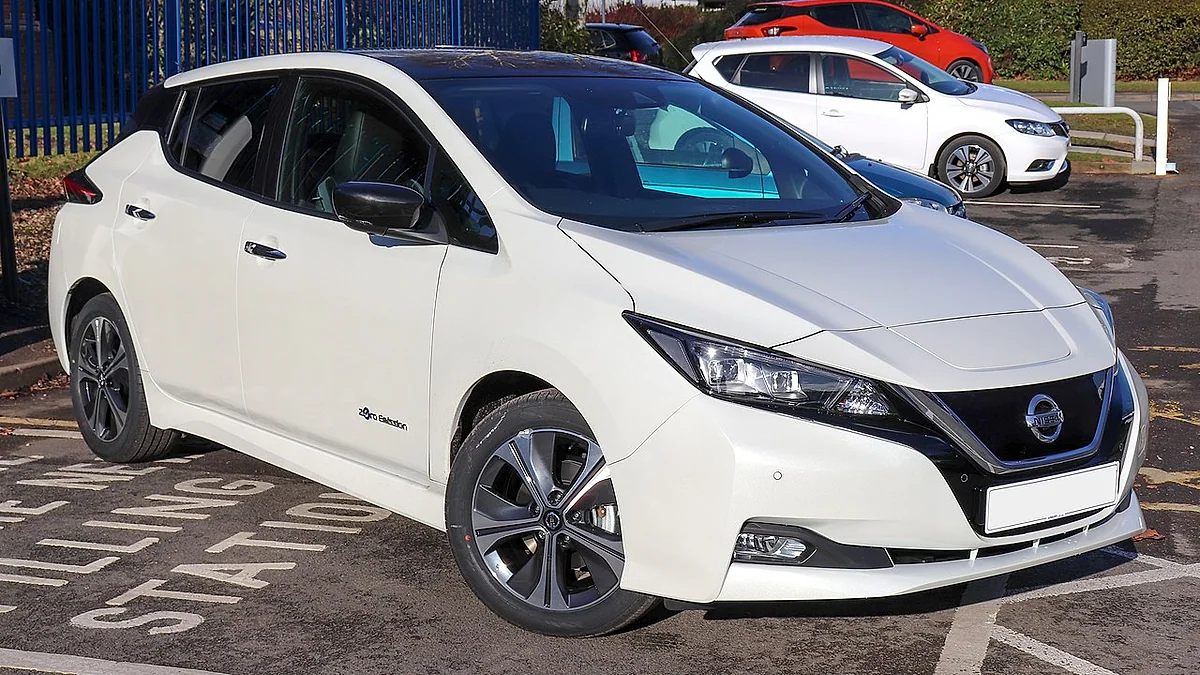
Nissan LEAF Charging in the UAE: Generation & Port Guide
Identify the Nissan LEAF generation before choosing a home charger or public fast charger: earlier cars and t…
Related Vehicle Guides
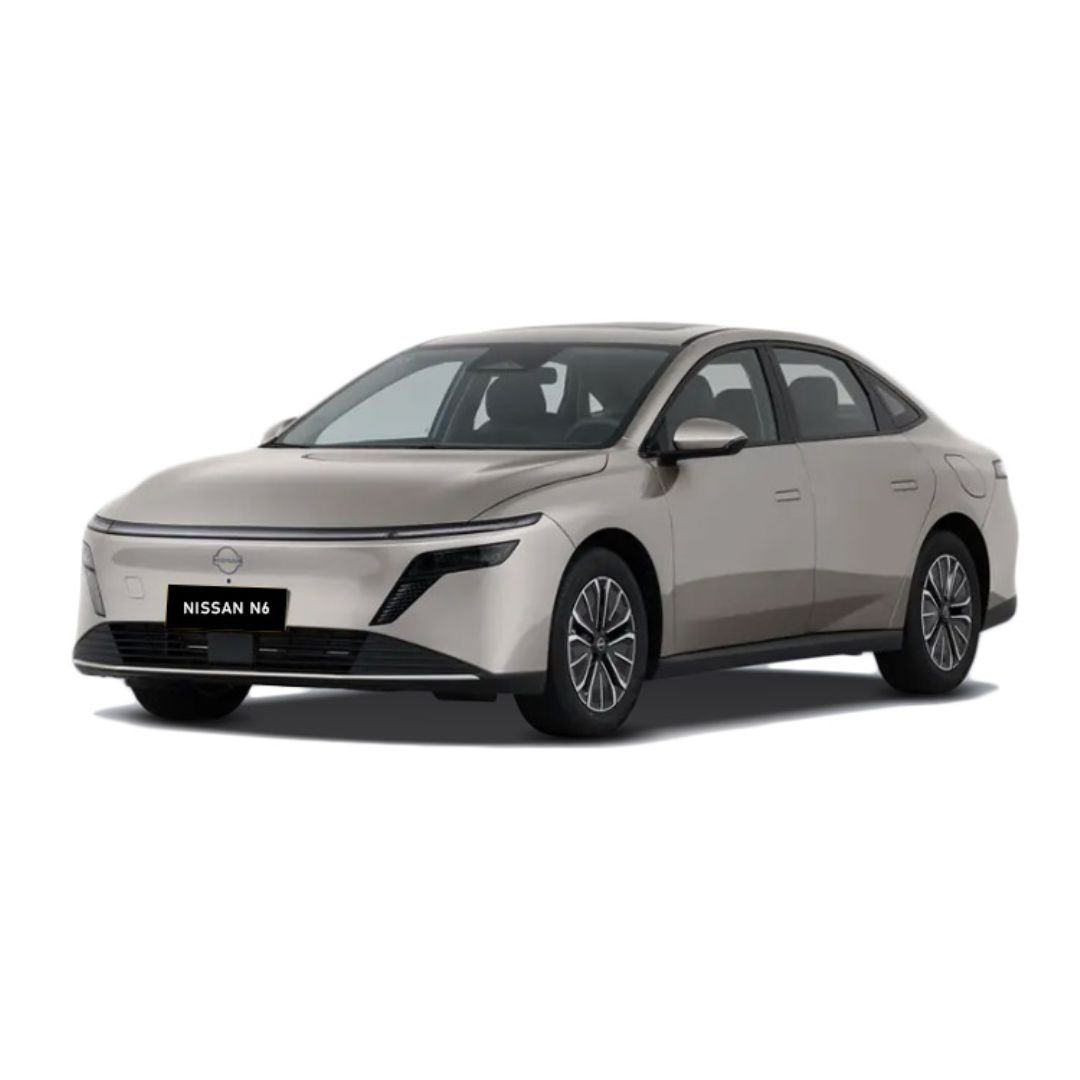
Nissan N6
Physical inlet must be inspected · Not published for the UAE import
Nissan ARIYA
Type 2 + CCS2 in reviewed European versions; other markets differ · 7.4 or 22 kW depending on battery and version
Nissan LEAF
Earlier cars may combine Type 1/Type 2 AC with CHAdeMO; third generation uses CCS · Depends on generation; third generation supports up to 11 kW on selected models